Quick Recommendation
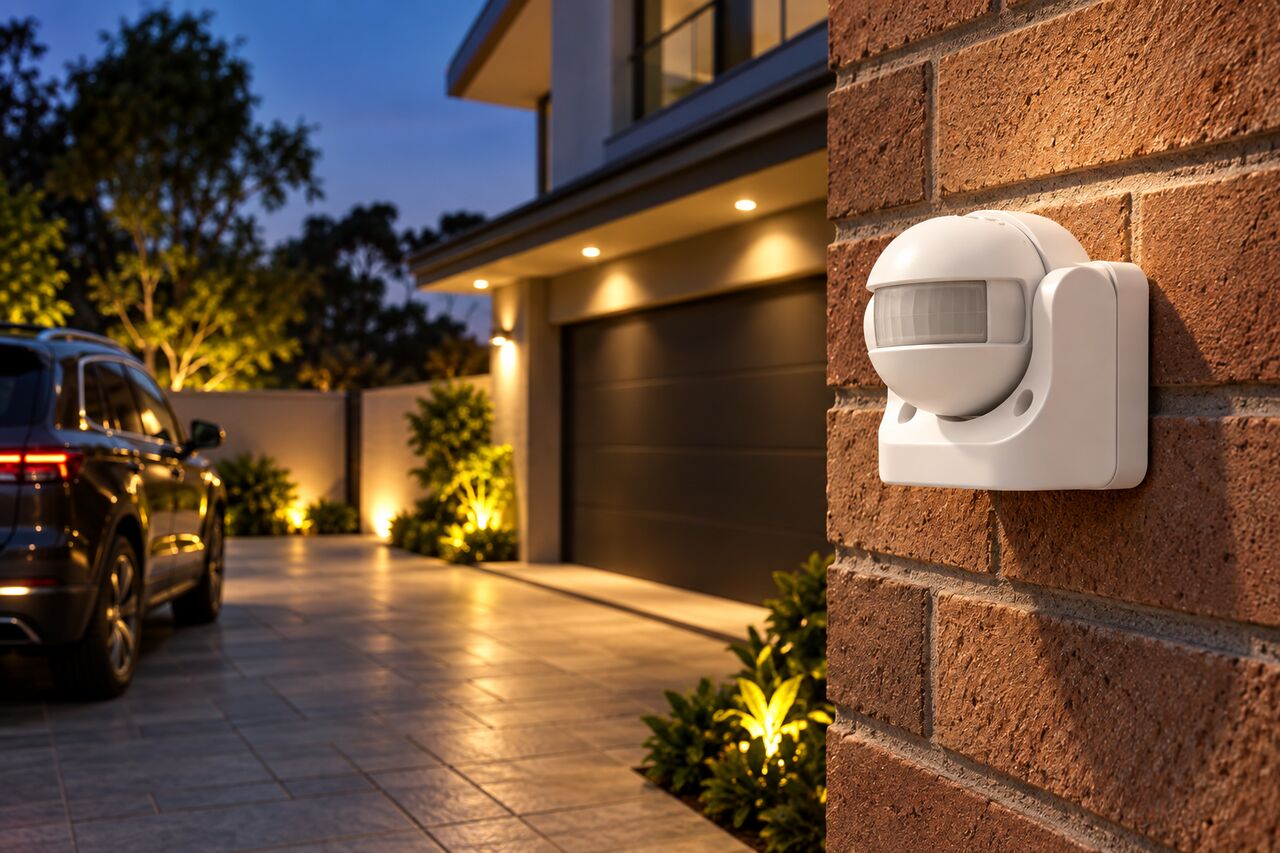
(i) Best for outdoor driveways, entry gates & building perimeters: Esysense Wall Mount PIR Motion Sensor — Features a 180° horizontal swivel head, IP44/IP65 weatherproofing, and 3-dial adjustment knobs for customized outdoor security lighting.
(ii) Best for indoor hallways, stairwells & switchboard retrofits: Adjustable Concealed Wall-Mount PIR Motion Sensor Switches — Fits directly into modular in-wall junction boxes to provide adjustable motion sensing across indoor passageways.
(iii) Best for open-plan offices, lobbies & wide rooms: 360-Degree Overhead Adjustable Ceiling PIR Sensors — Provides omnidirectional downward conical coverage with adjustable off-delay timers and ambient light thresholds.
(iv) Explore verified motion sensor options: Compare technical specifications, wiring schematics, and load capacities on the official Esysense Wall Mount PIR Motion Sensor.
Product Overview
Adjustable Passive Infrared (PIR) sensors combine pyroelectric heat detectors, multi-segmented Fresnel optical lenses, ambient photocells, and adjustable potentiometer dials within a flexible mounting profile.
(i) What it is: An AC-powered occupancy control module featuring 3-dial adjustment knobs (TIME, LUX, SENS) and a multi-angle swivel head for directional motion tracking.
(ii) What it does: Monitors infrared thermal radiation emitted by moving humans or vehicles, automatically energizing connected LED floodlights, panel lights, or tubelights when motion occurs in dark conditions.
(iii) Who it is intended for: Homeowners, facility managers, electrical contractors, security installers, and commercial property operators wanting customized lighting control.
(iv) Primary features: 180° wide-angle swivel neck, adjustable PIR sensitivity gain (2m to 12m detection radius), customizable off-delay timer (10 sec to 7 min), adjustable ambient daylight photocell (3 Lux to 2000 Lux), and IP44/IP65 weather sealing.
(v) Key specifications: Operating Voltage: 110V–270V AC, 50/60Hz; Switching Load Rating: 1200W Incandescent / 300W–500W LED load; Sensing Distance: 2 to 12 meters (adjustable); Operating Temperature: -20°C to +45°C; Standby Consumption: < 0.5W.
(vi) Main use cases: Outdoor driveways, garden pathways, home entryways, staircases, garages, balconies, and storage warehouses.
(vii) Important limitations: PIR sensors require an unobstructed optical line-of-sight; glass windows, solid walls, and dense bushes block thermal infrared detection.
Why This Matters
Installing a motion sensor without adjustment controls often leads to persistent frustration—such as lights turning on every time a stray cat walks by, floodlights triggering needlessly during broad daylight, or lights switching off too quickly while you carry groceries inside. Utilizing an adjustable PIR motion sensor solves these issues by letting you tailor detection boundaries and operational timing to your exact physical layout.
How Adjustable PIR Motion Sensors Work
An adjustable motion sensor translates thermal movement into automated electrical switching through an optical array, pyroelectric element, and three built-in tuning circuits:
1. Thermal Infrared Optical Sensing
The sensor lens features a curved Fresnel array that divides the surrounding 180° field into optical detection sectors. When a warm human body moves across these sectors, the shifting thermal contrast creates a voltage differential across the pyroelectric elements inside the sensor housing, triggering the internal relay circuit.
2. The Three Core Adjustment Controls (TIME, LUX, SENS)
Modern PIR sensors house three distinct control potentiometers (rotary dials) that regulate how the internal circuit behaves:
(i) TIME (Off-Delay Countdown): Determines how long connected lights stay illuminated after motion stops. Rotating the dial toward minimum sets a short delay (approx. 10 seconds), while turning it toward maximum extends the delay up to 7 minutes. Every new movement detected during the countdown resets the timer back to zero.
(ii) LUX (Daylight Suppression Photocell): Regulates ambient light sensitivity. Set to "Moon" (3 Lux), the sensor operates strictly in pitch-black night conditions. Set to "Sun" (2000 Lux), the photocell override is disabled, allowing motion activation 24 hours a day regardless of daylight.
(iii) SENS (PIR Sensitivity Control): Adjusts the gain of the internal pyroelectric amplifier. Turning SENS down shrinks the detection radius (e.g., down to 2–4 meters) to ignore distant movement; turning SENS up expands the reach up to 12 meters.
3. Swivel Head Mechanical Positioning
In addition to electronic dials, wall-mounted units like the Esysense Wall Mount PIR Motion Sensor feature a 180° horizontal and 90° vertical swivel neck. Tilting the sensor head down limits detection to your immediate doorstep, while angling it upward extends forward vision down a long driveway.
Main Decision Factors: Adjusting Coverage, Timing & Sensitivity
1. Calibrating SENS (PIR Sensitivity Control)
What to look for: Set the sensitivity dial based on your property line boundaries and target detection zone.
Why it matters: Setting sensitivity too high causes false triggers from passing cars, blowing tree branches, or neighborhood pets. Setting it too low causes delayed activation when walking into space.
Practical recommendation: Turn the SENS dial to maximum during initial walk-testing, then back it off gradually until movement outside your property boundary stops triggering the sensor.
2. Calibrating LUX (Daylight Photocell Threshold)
What to look for: Adjust the daylight dial to match surrounding ambient street lighting conditions.
Why it matters: If set fully to "Sun" (2000 Lux), lights will turn on during broad daylight every time someone passes, wasting energy. If set too close to "Moon" (3 Lux) in an area illuminated by nearby streetlamps, the sensor may mistakenly assume it is daytime and fail to turn on at night.
Practical recommendation: Adjust the LUX dial at dusk. Turn the dial slowly from "Moon" toward "Sun" until connected floodlights activate right at your preferred twilight level.
3. Setting TIME (Off-Delay Duration)
What to look for: Match the off-delay timer to the typical duration of activity in the room or walkway.
Why it matters: Short delays (10–30 seconds) suit passageways and driveways where people walk through quickly. Longer delays (3–7 minutes) suit garages, basements, and entry porches where people stand still while unlocking doors or loading vehicles.<