Quick Recommendation
(i) Best for staircases, hallways & midnight walkway safety: 3W PIR Motion Sensor Footlight — Fits into standard in-wall modular switch sockets to provide soft downward floor illumination without waking family members.
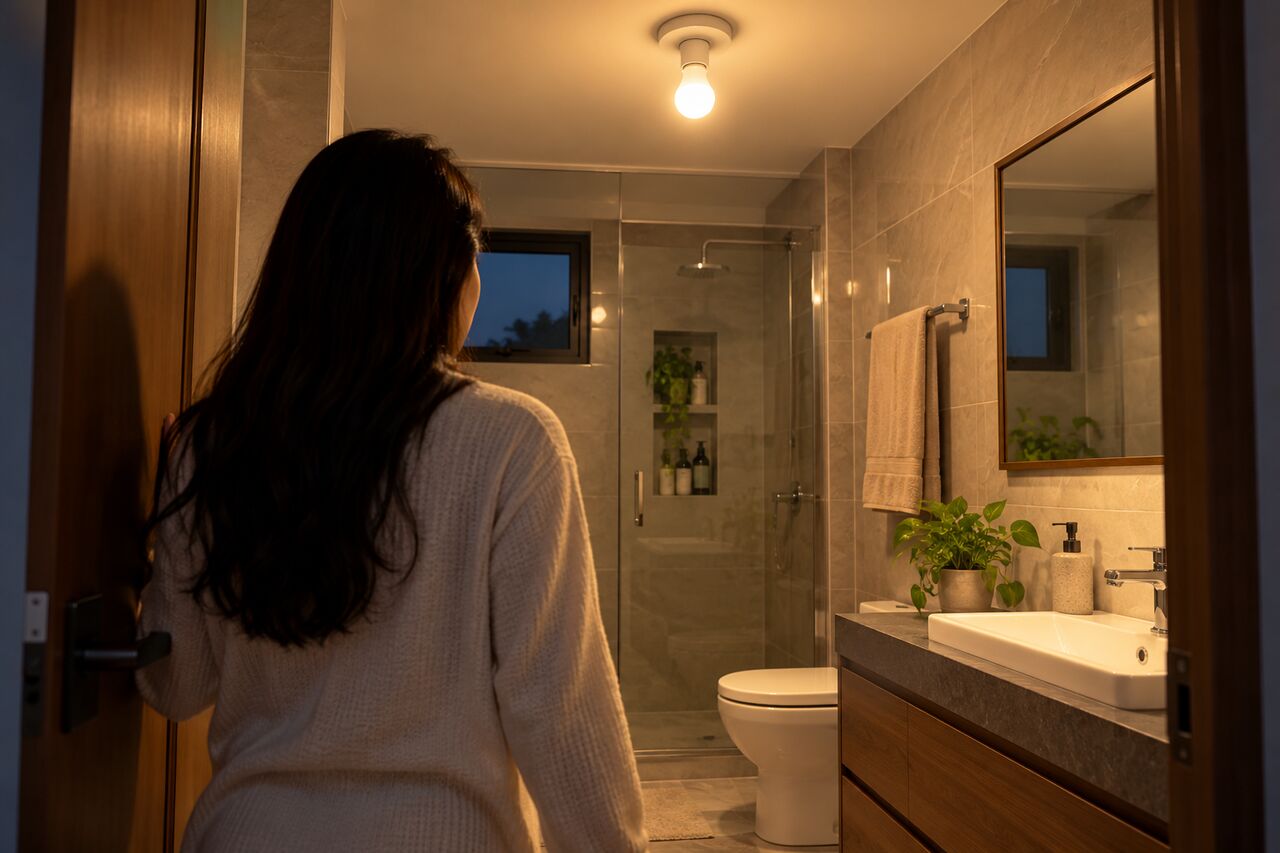
(ii) Best for quick retrofit in existing wall/ceiling light sockets: 10W B22 Motion Sensor LED Bulb — Screw or pin directly into standard Indian lamp holders for instant hands-free lighting in bedrooms, bathrooms, and utility areas.
(iii) Best for false ceilings, living rooms & modern corridors: 15W Motion Sensor Concealed Downlight / Panel Light — Fits flush into POP ceiling cutouts, delivering wide 360-degree overhead motion coverage.
(iv) Best for entrance gates, terraces & garden perimeters: IP65 Waterproof Motion Sensor Bulkhead or Solar Light — Weatherproof outdoor fixtures designed for long-range detection and dusk-to-dawn perimeter security.
(v) Explore complete home automation options: Read our comprehensive guide on how motion sensor lights work for home automation.
Product Overview
Automatic residential motion sensor lighting integrates solid-state surface-mounted diode (SMD) LEDs, optical Fresnel lenses, pyroelectric/radar sensing modules, and ambient photocells within functional home light profiles.
(i) What it is: A complete breakdown of residential motion-activated fixtures—including sensor bulbs, footlights, downlights, tubelights, and outdoor bulkheads—engineered for residential automation.
(ii) What it does: Automatically powers connected LED arrays when human motion is detected in low-light environments, disconnecting power after a pre-calibrated delay timer expires.
(iii) Who it is intended for: Homeowners, apartment dwellers, senior citizens, interior designers, and electrical renovators wanting switch-free lighting convenience.
(iv) Primary features: Integrated PIR thermal or Radar wave detection, ambient Lux photocell (prevents daytime operation), 30–60 second auto-off timer, plug-and-play sockets or surface/flush mounting, and IP20 to IP65 weatherproofing.
(v) Key specifications: Wattage Range: 3W (Footlight) to 20W (Panel/Tubelight); Voltage: 110V–270V AC, 50/60Hz (or 3.7V Lithium-ion for rechargeable/solar models); Detection Radius: 2 to 9 meters; (vi) Detection Angles: 120° to 360°; Color Temperatures: Warm White (3000K), Natural White (4000K), Cool White (6500K); Standby Power: < 0.3W.
(vii) Main use cases: Staircase steps, hallways, bathrooms, bedrooms, closets, kitchens, entrance porches, balconies, terraces, and driveways.
(viii) Important limitations: Indoor IP20 fixtures must be protected from rain; PIR models require an unobstructed optical line-of-sight to detect moving body heat signatures.
Why This Matters
Leaving hallway, bathroom, and porch lights turned ON continuously overnight causes unnecessary utility bill spikes and accelerates LED driver wear. Installing a dedicated sensor light for home spaces guarantees that light is delivered only when family members are physically present. This protects children and elderly relatives from trip hazards in dark corridors, eliminates switch hunting with full hands, and slashes home lighting power costs.
How Home Sensor Lights Work
A modern home sensor light coordinates optical sensing, thermal/Doppler detection, and smart driver switching within its housing:
1. Dual Sensing Architecture (PIR / Radar + Lux Photocell)
Residential sensor lights combine occupancy tracking with daylight suppression:
Passive Infrared (PIR) Thermal Sensing: Detects shifting infrared thermal radiation naturally emitted by human body heat (37°C) across optical Fresnel lens zones.
Microwave / Radar Sensing: Emits low-power 5.8GHz electromagnetic signals and measures reflected frequency shifts (Doppler Effect), detecting movement through thin glass, plastic, or acrylic diffusers.
Ambient Daylight Suppression (Photocell): Measures surrounding room light. If natural daylight exceeds 10 to 15 Lux, the photocell keeps the light circuit dormant, preventing power waste during daytime hours.
2. Smart Driver Regulation & Auto-Off Delay
Once motion is detected in dark conditions, the driver energizes the LED array to 100% full brightness in under 0.1 seconds. An internal timer maintains illumination as long as movement continues. Once the room becomes vacant, the timer counts down 30 to 60 seconds before safely cutting power to an ultra-low standby state (< 0.3W).
Main Decision Factors: Choosing the Right Sensor Lights for Home
1. Space Function & Room Layout Matching
What to look for: Match the fixture form factor to the physical layout and activity level of the target room.
Why it matters: High-brightness overhead panels suit open kitchens and living rooms, whereas low-glare 3W footlights suit midnight staircase navigation. Using an oversized panel in a narrow hallway causes harsh glare, while an undersized bulb in a wide garage leaves corners dark.
Practical recommendation: Use footlights for staircases and midnight pathways; use concealed downlights for POP false ceilings; use sensor bulbs for quick retrofits in existing wall lamps. Learn more layout tips in our home sensor light guide.
2. Mounting Style: Retrofit Socket vs. Flush Ceiling vs. Wall-In Recessed
What to look for: Inspect existing wiring points and ceiling structures before selecting fixtures.
Why it matters: Plug-and-play motion bulbs fit directly into standard Indian B22 bayonet wall holders without tools. Concealed downlights clip flush into POP false ceiling cutouts, while footlights fit inside modular wall switchboards.
Practical recommendation: Choose motion bulbs for instant, tool-free retrofits; choose concealed downlights or panel lights for new false ceiling construction; choose footlights during switchboard wiring upgrades.
3. Indoor IP20 vs. Outdoor IP65 Weather Protection
What to look for: Check ingress protection (IP) ratings based on moisture and rain exposure.
Why it matters: Indoor IP20 lights lack moisture seals and will short-circuit if exposed to monsoon rain or heavy steam. Outdoor IP65 bulkheads and solar lights feature silicone weather gaskets and UV-resistant casings designed for direct rain exposure.
Practical recommendation: Deploy IP20 fixtures inside bedrooms, hallways, and dry living areas; select IP65 waterproof bulkheads or solar floodlights for main entry gates, terraces, and open gardens.
Technical Specification Comparison
1. 3W P