Quick Recommendation
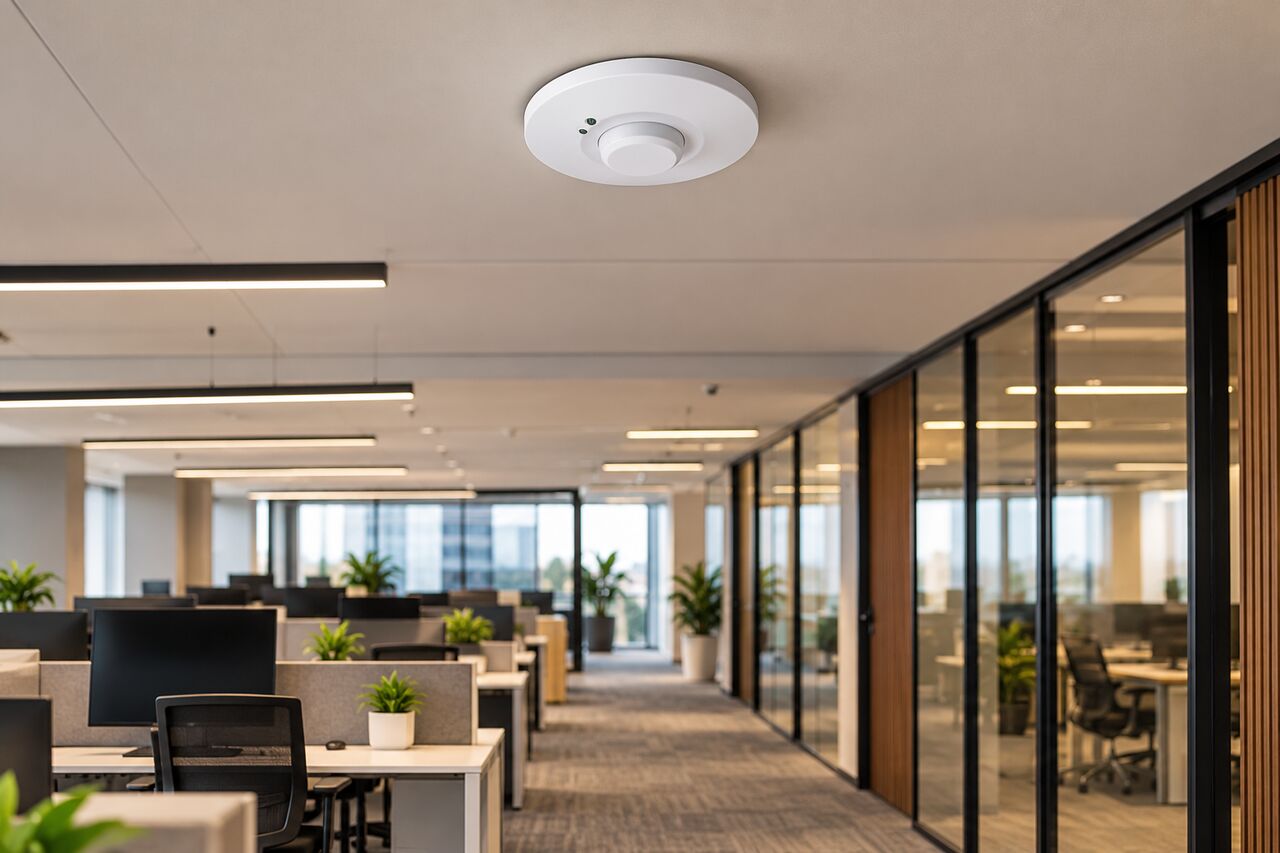
(i) Best for residential & commercial ceilings (Surface Mount 360°): Surface-Mount Microwave Motion Sensor — Delivers omnidirectional 360-degree high-frequency detection across indoor rooms, lobbies, and hallways.
(ii) Best for industrial warehouses, factories & high-ceiling bays: High-Bay Microwave Motion Sensor — Engineered with high-gain antennas to detect vehicular and foot traffic from mounting heights up to 15 meters.
(iii) Best for adjustable sensitivity & custom coverage tuning: Adjustable Microwave Motion Sensor Module — Features rotary potentiometers for precision tuning of detection range, time delay, and ambient Lux thresholds.
(iv) Explore complete radar sensor options: Compare specifications, load ratings, and order directly from the official Esysense Radar Motion Sensor.
Product Overview
Automatic radar motion lighting switches integrate high-frequency microwave transceiver antennas, microprocessors, ambient Lux photocells, and heavy-duty electromagnetic switching relays inside compact ceiling or wall profiles.
(i) What it is: An active electronic motion-sensing control switch that uses 5.8GHz radio frequency waves to detect physical displacement across indoor and outdoor spaces.
(ii) What it does: Continuously transmits low-power radio waves and analyzes returned echo frequency shifts to power connected LED lights ON instantly upon movement, turning them off after inactivity timers expire.
(iii) Who it is intended for: Facility managers, industrial warehouse operators, commercial building engineers, electrical contractors, and property owners wanting wide-area motion automation.
(iv) Primary features: 5.8GHz high-frequency microwave technology, 360-degree omnidirectional coverage, wall/glass penetration capability, adjustable sensitivity gain, customizable time delays (10s to 15m), and ambient daylight Lux sensors.
(v) Key specifications: Operating Voltage: 110V–270V AC, 50/60Hz; Transmission Frequency: 5.8GHz (< 0.2mW low radiation output); Switching Load Capacity: 300W–500W LED / 1200W–2000W Resistive; Detection Range: 2 to 12 meters radius; Mounting Height: 2.2m to 15m (High-Bay models).
(vi) Main use cases: Underground parking garages, industrial warehouses, commercial office corridors, glass-walled conference rooms, multi-stall restrooms, and stairwells.
(vii) Important limitations: Because radar waves penetrate thin partitions and glass, high sensitivity settings can cause unwanted light activation from movement in adjacent rooms or hallways if not properly calibrated.
Why This Matters
Traditional PIR motion sensors often fail in commercial environments with glass office partitions, high ambient summer temperatures, or large obstacles that block thermal line-of-sight. Deploying a radar motion detector solves these limitations by utilizing active radio wave propagation, guaranteeing seamless motion detection through glass and light building materials without missing a step.
How Radar Motion Detectors Work
A radar sensor operates on active electromagnetic wave physics and the Doppler effect:
1. Active 5.8GHz Wave Transmission
Unlike PIR sensors that only listen for passive infrared radiation, a microwave motion detector actively transmits low-power 5.8GHz radio frequency signals from an onboard planar antenna. These waves fill the surrounding space, bouncing off walls, floors, furniture, and human bodies.
2. The Doppler Effect & Frequency Shift Analysis
When an object moves within the detection field, the reflected radio waves bounce back with a slightly modified frequency (known as the Doppler shift). The internal microprocessor instantly compares the transmitted frequency against the received echo frequency. When a frequency shift is registered, the internal relay closes the AC circuit to illuminate connected fixtures.
3. Obstacle Penetration Mechanics
Because 5.8GHz radio waves pass freely through glass windows, plastic light diffusers, wooden doors, and drywalls, a microwave radar sensor can be concealed entirely inside decorative fixtures, false ceilings, or behind junction box covers while maintaining full functional performance.
Main Decision Factors: Choosing a Radar Motion Sensor
1. Mounting Height & Facility Scale (Standard vs. High-Bay)
What to look for: Match the radar sensor's transmission power and antenna gain to your ceiling height.
Why it matters: Standard ceiling radar sensors operate effectively at heights of 2.2 to 4 meters in offices and hallways. Industrial warehouses and factory floors with ceilings spanning 8 to 15 meters require specialized high-bay radar sensors with concentrated high-gain beams.
Practical recommendation: Choose standard surface-mount radar sensors for residential and commercial ceilings; specify high-bay radar sensors for industrial storage halls and factory floors available via the official Esysense Radar Motion Sensor.
2. Sensitivity Calibration & Wall Penetration Control
What to look for: Look for adjustable sensitivity dials (SENS) on the sensor module.
Why it matters: Because microwave signals pass through drywall and glass, an uncalibrated high-sensitivity radar sensor installed in a thin-walled apartment corridor might trigger whenever someone walks in the neighboring room.
Practical recommendation: Choose adjustable microwave sensor models so you can fine-tune the detection radius to match your exact room boundaries and prevent false triggers from adjacent zones.
3. Integrated Daylight Photocell (Lux Suppression)
What to look for: Ensure the radar unit includes an adjustable ambient Lux threshold sensor.
Why it matters: Even if an area is occupied, lighting is unnecessary during daytime hours when natural sunlight fills the room.
Practical recommendation: Configure the built-in Lux photocell so the radar switch remains dormant when natural ambient light exceeds 30 to 50 Lux.
Technical Specification Comparison
1. Surface-Mount 360° Microwave Radar Sensor
Frequency & Technology: 5.8GHz High-Frequency Active Doppler Radar.
Detection Coverage: 360° Omnidirectional.
Mounting Height: 2.2 to 4.0 Meters (Ceiling or Wall).
Load Rating: Up to 500W LED / 1200W Resistive.
Adjustability: Time Delay, Lux Threshold, and Sensitivity Dials.
Best Application: Commercial corridors, off