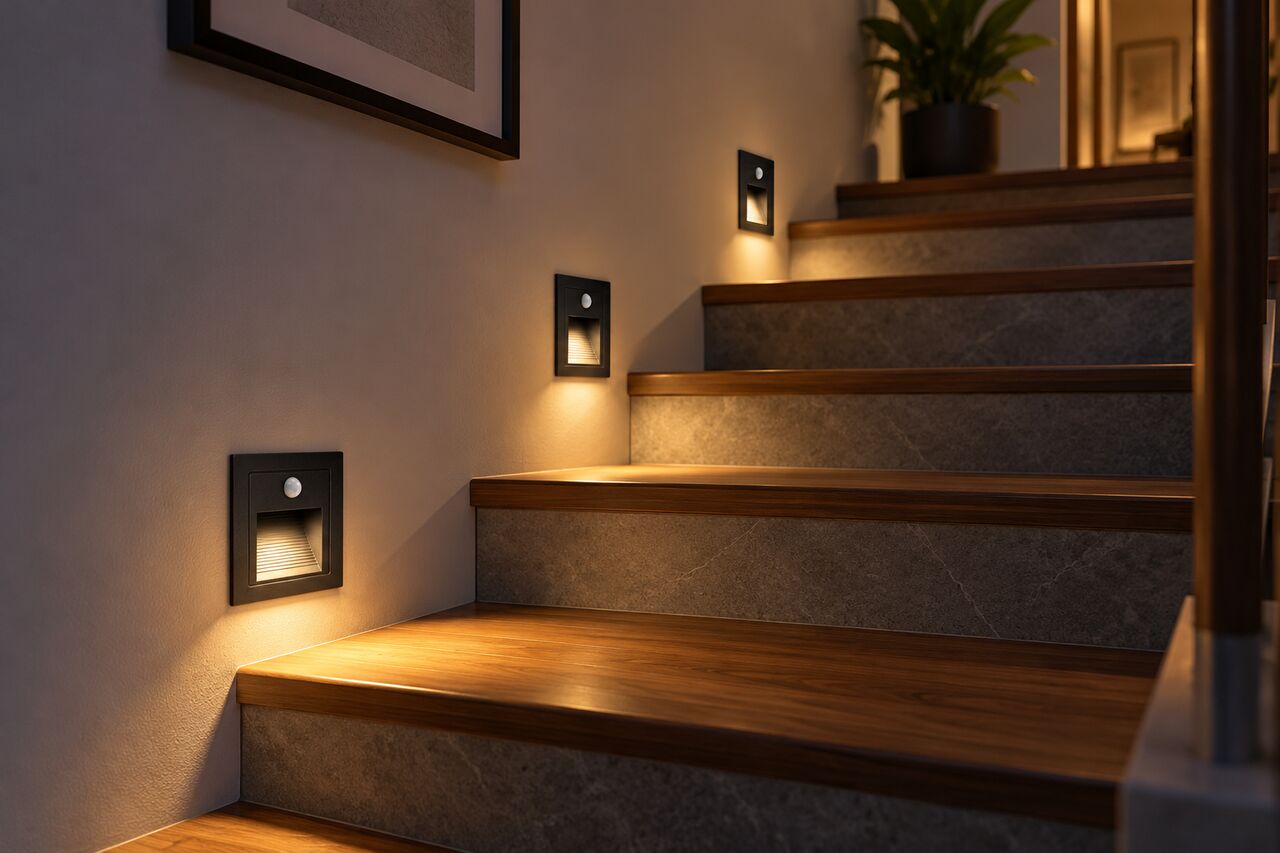
Quick Recommendation
(i) Best for wall-recessed step illumination & nighttime walkway guidance: Esysense 3W PIR Motion Sensor Foot Light — Compact, glare-free modular footlights that mount into standard switch boxes to illuminate individual step treads automatically.
(ii) Best for dynamic, step-by-step sequential LED strip animations: Multi-Channel Staircase LED Controllers — Automatically fires channel-by-channel strip lighting down wooden, marble, or glass staircases upon motion detection.
(iii) Best for complete turnkey stair automation: Staircase Controller Sensor Kits — Complete bundled packages including controllers, 12V/24V LED strip rolls, PIR sensors, and power supply units.
(iv) Explore the complete staircase lighting range: Compare specifications, finishes, and order directly from the official Esysense Motion Sensor Foot Light.
Product Overview
Modern staircase automation integrates infrared motion tracking, low-voltage direct current (DC) power supplies, and multi-channel microcontroller timing units to manage step lighting.
(i) What it is: An advanced micro-controller-based automation system designed to sequence and control LED illumination across individual stair treads or corridor footlights.
(ii) What it does: Automatically activates lighting circuits step-by-step or floor-by-floor when motion is detected at staircase thresholds, holding illumination during transit and shutting off after a preset timer expires.
(iii) Who it is intended for: Homeowners, interior designers, modular stair builders, electrical contractors, and facility managers seeking luxury aesthetics combined with absolute nighttime safety.
(iv) Primary features: PIR motion sensor inputs (top and bottom landing), programmable time delay (4 sec to 200 sec), adjustable animation speed control, ambient Lux photocell daylight suppression, and multi-channel LED driver outputs.
(v) Key specifications: Operating Voltage: 12V–24V DC; Max Channel Support: Up to 32 Step Channels / 512 Pixels; Detection Technology: PIR Thermal Infrared; Detection Angle: 120° to 180°; Standby Power: < 0.5W; IP Rating: IP20 indoor protection.
(vi) Main use cases: Duplex staircases, villa floating steps, commercial mall escalators, hotel multi-level lobbies, and residential hallway landings.
(vii) Important limitations: Low-voltage DC staircase controllers require proper wire gauge sizing and must be installed within reach of dedicated 12V/24V SMPS power supply units.
Why This Matters
Traditional staircase lighting typically relies on single switches at the top and bottom, forcing family members to navigate dark steps or leave harsh overhead lights burning all night. Implementing an intelligent lighting control system for staircase spaces solves this by delivering precise, glare-free step illumination only when movement occurs, protecting children and elderly relatives from slip-and-fall hazards while reducing energy waste.
How Intelligent Staircase Control Systems Work
An automatic stair controller coordinates sensors, microprocessors, and LED output drivers in three synchronized stages:
1. Landing Detection (PIR Trigger Signals)
Passive Infrared (PIR) sensors installed at the bottom and top landing thresholds continuously monitor thermal body heat (37°C). When a person approaches either end of the staircase, the lower or upper sensor registers a thermal voltage spike and sends a trigger signal to the central controller.
2. Microcontroller Sequencing & Timing
Upon receiving a trigger signal, the internal microprocessor evaluates the ambient room light via a built-in Lux sensor (ensuring lights stay OFF during daytime). If dark, the controller executes a programmed sequence:
(i) Step-by-Step Cascading: Fires output channels sequentially (from bottom to top when ascending, or top to bottom when descending) at a custom-adjusted speed.
(ii) Full Hold Duration: Keeps all steps illuminated during transit for a calibrated time delay (ranging from 4 seconds up to several minutes).
(iii) Gradual Fade-Out: Safely dims and extinguishes the stair lights once the timer expires.
3. Step-by-Step Wall Footlighting Alternative
For simplified installations without under-tread LED strips, recessed fixtures like the Esysense 3W PIR Motion Sensor Foot Light integrate individual PIR sensors directly into each low-level wall plate to illuminate individual steps instantly upon approach.
Main Decision Factors: Choosing a Staircase Lighting System
1. Lighting Style: Under-Tread Strip Cascading vs. Wall Footlights
What to look for: Decide between dynamic sequential step strips or static wall-recessed footlights.
Why it matters: Cascading LED strip controllers deliver a stunning, luxury architectural statement that illuminates every single tread sequentially. Wall-recessed footlights like the Esysense 3W PIR Motion Sensor Foot Light offer a simpler, wire-free modular wall installation ideal for budget retrofits.
Practical recommendation: Choose multi-channel stair controllers and under-tread strips for luxury architectural staircases; select modular motion sensor footlights for quick switch-box installations.
2. Programmability: Speed, Timing & Brightness Adjustments
What to look for: Look for controllers offering digital interface controls or DIP switches for timing and speed tuning.
Why it matters: Rapid stair climbing requires fast cascade speeds, whereas elderly occupants benefit from slower, extended lighting delays and higher brightness.
Practical recommendation: Choose controllers featuring digital display interfaces and adjustable
speed settings (150ms–2600ms) to customize the walking experience.
3. Load Capacity & Power Supply Sizing
What to look for: Match the controller's channel count and total wattage to the length of your LED strips.
Why it matters: Driving 16 to 32 channels of high-density 12V LED strips requires robust SMPS power supplies (typically 10A to 30A) to prevent voltage drop and dimming at the far end of the run.
Practical recommendation: Ensure your SMPS power supply is rated for at least 20% more wattage than the total connected LED strip load.
Technical Specification Comparison
1. 3W PIR Motion Sensor Foot Light
Control Architecture: Independent Modular PIR Sensor + LED Driver.
Voltage & Power: 220V–240V AC / 3W Low Power Consumption.
Illu