Quick Recommendation
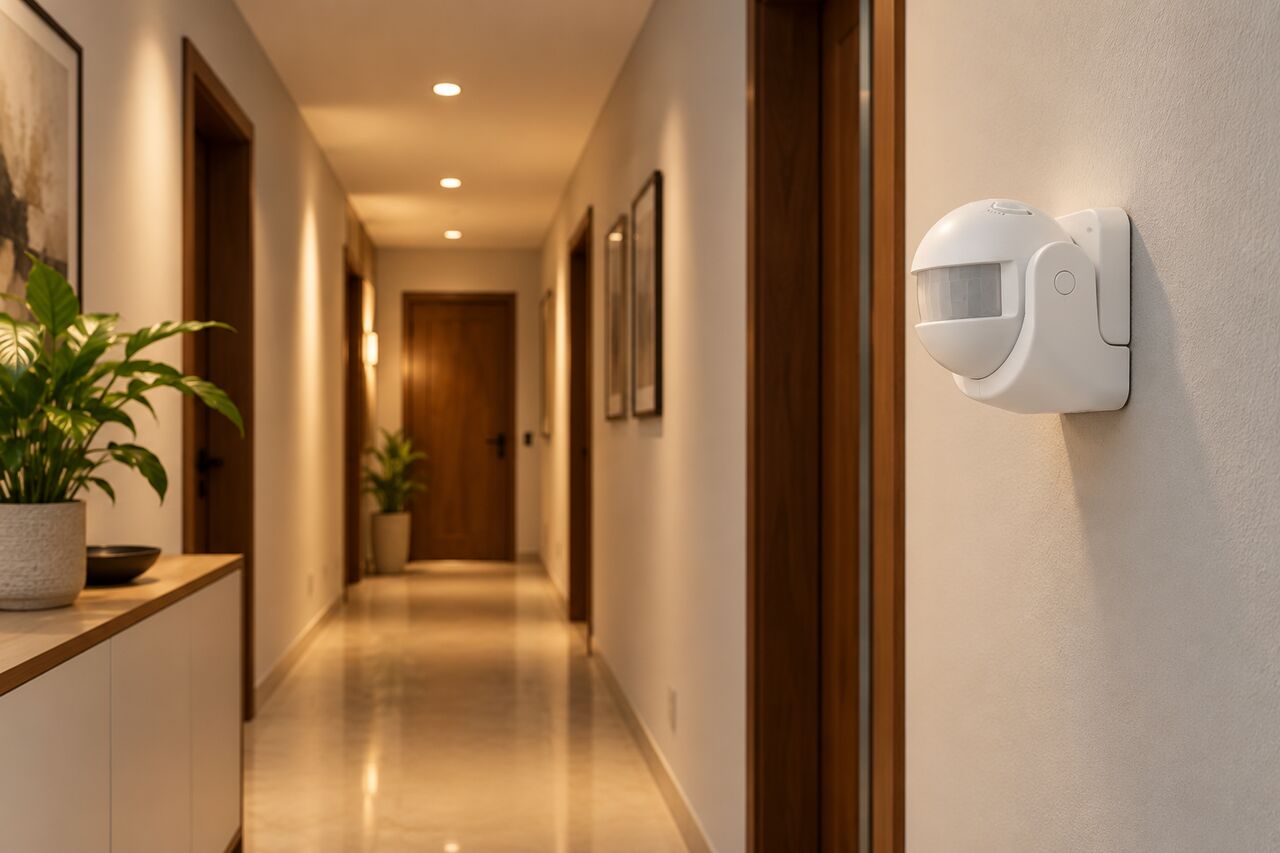
(i) Best for residential hallways, stair landings & entrance foyers (Indoor Wall Mount): Esysense 180° Wall Mount PIR Motion Sensor (ESY-P09) — Features adjustable time delay, precise Lux sensitivity, and a compact 80mm profile for seamless indoor automation. Explore specifications and order directly from the official Esysense Wall Mount PIR Motion Sensor.
(ii) Best for outdoor driveways, boundary gates & exterior building walls (Weatherproof): Outdoor 180° Adjustable PIR Sensor — IP65-rated weatherproof construction engineered to withstand monsoon rain and dust storms while securing exterior pathways.
(iii) Best for customizable directional control: Swivel-Head 180° PIR Motion Detector — Allows horizontal and vertical lens tilting to focus coverage on specific walking paths while ignoring street traffic.
Product Overview
Wall-mounted passive infrared (PIR) sensors combine pyroelectric thermal elements, wide-angle Fresnel lens arrays, ambient Lux photocells, and adjustable rotary potentiometers within durable architectural housings.
(i) What it is: A surface-mounted electronic occupancy switch engineered for vertical wall installation to provide expansive 180-degree lateral motion detection for AC lighting circuits.
(ii) What it does: Continuously measures far-infrared thermal radiation across its hemispherical field of view, closing an internal relay to power connected lights instantly when a warm body moves through the zone.
(iii) Who it is intended for: Homeowners, electrical contractors, property managers, security installers, and facility engineers seeking reliable wall-mounted lighting automation.
(iv) Primary features: 180° horizontal optical field of view, dual pyroelectric sensor elements, adjustable Lux photocell threshold (3 to 2000 Lux), customizable off-delay timer (3 sec to 15 min), and wall-mounting bracket.
(v) Key specifications: Operating Voltage: 110V–270V AC, 50/60Hz; Switching Load Capacity: Up to 300W LED / 1200W Incandescent; Detection Range: Max 8m to 12m radius; Installation Height: 1.8 to 4.0 meters; Standby Power Consumption: < 0.5W.
(vi) Main use cases: Building corridors, stairwell entry walls, garage driveways, boundary gates, outdoor pathways, and balcony perimeter walls.
(vii) Important limitations: PIR sensors require an unobstructed optical line-of-sight and cannot detect thermal movement through solid brick walls or closed glass doors.
Why This Matters
Installing ceiling-mounted sensors is not always practical in spaces with solid concrete slabs or finished false ceilings where wiring cannot be dropped from above. A wall-mounted 180-degree PIR sensor mounts easily onto standard junction boxes or exterior brick walls, providing sweeping lateral coverage that monitors entire room entryways and hallways effectively.
How 180-Degree PIR Sensors Work
A wall mount PIR unit converts human body heat into an automated electrical switching signal through a three-stage optical and electronic process:
1. Hemispherical Fresnel Lens Array & Thermal Sensing
The protruding dome of a 180 degree motion sensor consists of a multi-faceted Fresnel lens split into dozens of distinct optical zones. This lens focuses far-infrared thermal radiation onto two internal pyroelectric sensor elements.
2. Lateral Movement Detection Logic
PIR sensors are most sensitive to motion crossing perpendicular to the sensor beams rather than walking directly toward the lens. When a person walks laterally across the 180° field, their body heat (37°C) alternates between lens segments, creating a voltage differential that triggers the internal relay.
3. Integrated Dials (TIME, LUX, SENS)
Modern wall-mount units feature physical rotary potentiometers allowing precise calibration:
TIME: Sets how long lights stay ON after motion ceases (3 seconds to 15 minutes).
LUX: Sets ambient daylight thresholds (<3 to 2000 Lux), ensuring lights remain dormant during daytime hours.
SENS: Regulates detection distance and amplification gain.
Main Decision Factors: Choosing a Wall-Mount PIR Sensor
1. Indoor vs. Outdoor Weatherproofing (IP20 vs. IP65)
What to look for: Inspect the installation environment for moisture, rain, and dust exposure.
Why it matters: Indoor IP20 units suit protected hallways and stairwells. Outdoor installations along exposed boundary walls or driveways require rugged IP65 weatherproof seals to prevent water ingress during monsoon rains.
Practical recommendation: Specify IP20 wall units for indoor corridors; choose IP65 weatherproof models for exterior gates and perimeter walls.
2. Mounting Height & Lateral Positioning
What to look for: Plan your mounting height (1.8m to 4m) and lateral approach angles.
Why it matters: Mounting the sensor perpendicular to primary walking paths maximizes detection sensitivity. Placing the unit too low risks blind spots behind furniture; placing it too high reduces floor-level thermal detection.
Practical recommendation: Mount wall PIR sensors at a height of 2.2 to 2.5 meters facing across the walkway for optimal trigger reliability.
3. Load Capacity & LED Driver Compatibility
What to look for: Verify that the sensor's switching relay can handle your total connected LED wattage.
Why it matters: Standard electronic switches handle up to 300W of LED lighting, which is more than sufficient for residential hallways, but high-power commercial floodlight circuits require higher resistive load ratings.
Practical recommendation: Check fixture wattage before wiring to ensure safe compatibility with your chosen wall switch model available at Esysense Wall Mount PIR Motion Sensor.
Technical Specification Comparison
1. 180° Wall Mount PIR Motion Sensor (ESY-P09)
Detection Coverage: 180° Horizontal Hemispherical Field.
Detection Range: Max 8 meters radius.
Operating Voltage: 110V–270V AC, 50/60Hz.
Switching Load Capacity: Up to 300W LED / Resistive Load.
Adjustability: Time Delay (3 sec to 15 min), Ambient Lux (<3 to 2000 Lux).
Mounting & Rating: Surface Wall Mount / IP20 Indoor Protection.
Best Application: Indoor corridors, stairwell landings, entrance foyers, and utility rooms.
2. Outdoor IP65 Weatherproof 180° PIR Sensor
Detection Coverage: 180° Wide-Angle Field.
Detection Range: Up to 12 meters radius.
Operating Voltage: 110V–270V AC, 50/60Hz.
Switching Load Capacity: Up to 500W LED / 1200W Incandescent.
Adjustability: Time Delay, Lux, and Sensitivity Dials.
Mounting & Rating: Surface Wall Mount