Quick Recommendation
(i) Best for residential hallways, bathrooms & quick retrofit lighting: Esysense Motion Sensor LED Bulbs — Screw or pin directly into standard lamp holders for instant plug-and-play automation.
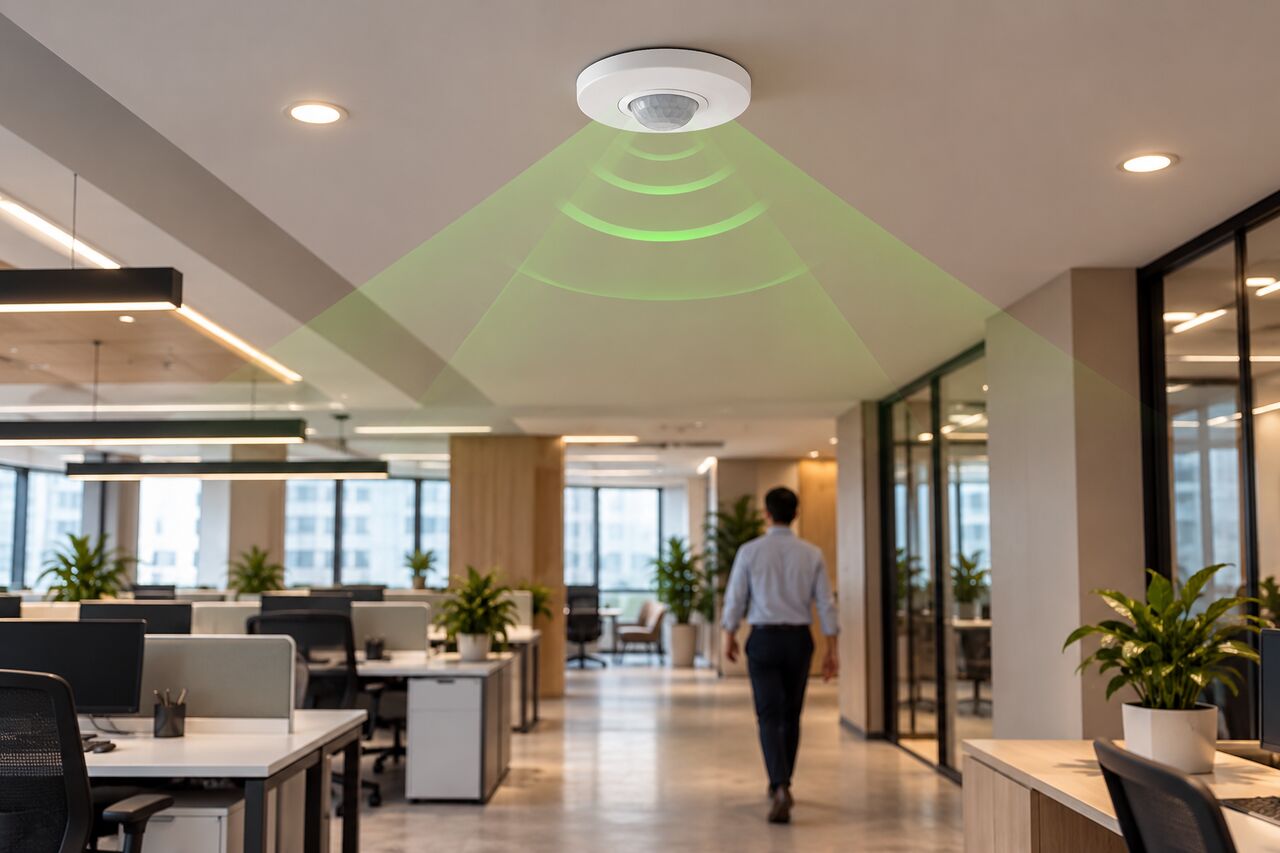
(ii) Best for POP false ceilings, office corridors & wide rooms: Esysense 360° Ceiling PIR & Microwave Radar Sensors — Provide omnidirectional overhead occupancy detection.
(iii) Best for outdoor security, street poles & boundary walls: Esysense IP65 Photocell LDR Switches & Outdoor PIR Floodlights — Automate dusk-to-dawn exterior perimeter lighting.
Product Overview
Automatic lighting automation relies on selecting the correct sensing technology to match physical room dimensions, environmental conditions, and architectural layouts.
(i) What it is: A comprehensive technical guide to understanding, comparing, and deploying Esysense’s diverse range of occupancy, presence, daylight, and proximity sensors.
(ii) What it does: Automatically completes electrical lighting circuits when human presence, motion, or twilight conditions are detected, ensuring lights operate exclusively when needed.
(iii) Who it is intended for: Homeowners, interior architects, electrical contractors and housing society managers.
(iv) Primary features: PIR thermal infrared detection, 5.8GHz microwave Doppler radar, ambient Lux daylight suppression, adjustable time delays (10s to 15m), and low standby power (<0.5W).
(v) Key specifications: Operating Voltage: 110V–270V AC (and 12V/24V DC for cabinet sensors); Detection Range: 2 meters to 12 meters; Ingress Ratings: IP20 indoor to IP65 weatherproof outdoor.
(vi) Main use cases: Staircases, residential corridors, office meeting rooms, modular wardrobes, and outdoor boundary walls.
(vii) Important limitations: PIR sensors require line-of-sight thermal visibility; high-sensitivity microwave radar sensors can penetrate thin partitions if uncalibrated.
Why This Matters
Installing mismatched sensors—such as placing a basic PIR sensor behind thick glass or expecting a daylight photocell to detect motion—results in lighting automation failures. Familiarizing yourself with the technology behind each Esysense sensor ensures optimal placement, flawless hands-free convenience, and maximum electricity savings.
How Esysense Sensors Work
Esysense incorporates four primary sensing mechanisms across its product ecosystem:
1. Passive Infrared (PIR) Thermal Sensing
Esysense PIR sensors utilize pyroelectric elements protected behind multi-faceted Fresnel lenses. They monitor ambient infrared body heat. When a person moves across the optical field, the thermal voltage spike closes the internal relay.
2. High-Frequency 5.8GHz Microwave Radar Detection
Active Esysense radar sensors transmit low-power 5.8GHz radio frequency waves and analyze Doppler frequency shifts in returned echoes. Because these waves penetrate glass, plastic, and drywall, radar sensors excel in glass-walled offices and enclosed fixtures.
3. Ambient Lux Photocell Day-Night Switching
Integrated Light Dependent Resistors (LDRs) measure natural daylight. When ambient light exceeds pre-set thresholds (e.g., 15 to 50 Lux), the photocell suppresses motion activation during bright daylight hours.
4. IR Proximity Cabinet Sensing
Esysense wardrobe sensors emit focused infrared beams inside enclosed closets, keeping lights OFF when doors are closed and turning them ON instantly when doors open.
Main Decision Factors: Choosing the Right Esysense Sensor
1. Sensing Technology: PIR vs. Radar vs. Photocell
What to look for: Match the sensor technology to your room environment and structural barriers.
Why it matters: Use PIR sensors for standard open rooms and corridors where false triggers from adjacent zones must be avoided. Use microwave radar sensors for glass-walled conference rooms or enclosed globes. Use photocell switches for outdoor dusk-to-dawn lighting, and IR proximity sensors for wardrobes.
Practical recommendation: Review application requirements before selecting an Esysense motion sensor model from the official Esysense website.
2. Mounting Style & Form Factor
What to look for: Determine whether you need retrofit bulbs, recessed ceiling panels, surface wall-mount units, or modular switch-box footlights.
Why it matters: Retrofit bulbs require zero wiring changes, slipping directly into existing lamp sockets. Recessed downlights require false ceiling cutouts, while wall-mount PIR units mount on vertical brick surfaces.
Practical recommendation: Choose plug-and-play sensor bulbs for quick room upgrades; specify recessed panels for POP false ceilings.
3. Environmental Durability
What to look for: Evaluate moisture, dust, and weather exposure at the installation site.
Why it matters: Indoor IP20 sensors suit dry living areas and hallways. Outdoor boundary walls and street poles require IP65 weatherproof seals to prevent monsoon water damage.
Practical recommendation: Always select IP65-rated Esysense outdoor sensors for exposed exterior perimeters.
Technical Specification Comparison
1. PIR Motion Sensor (Wall / Ceiling Mount)
Sensing Technology: Passive Infrared Thermal Detection.
Coverage Field: 180° Wall Mount or 360° Ceiling Cone.
Detection Distance: Up to 8 to 12 meters radius.
Adjustability: TIME, LUX, and SENS rotary potentiometers.
Best Application: Indoor stairwells, hallways, and building perimeters.
2. 5.8GHz Microwave Radar Sensor
Sensing Technology: High-Frequency Active Doppler Radar.
Coverage Field: 360° Omnidirectional (Wall/Glass Penetration).
Detection Distance: Up to 10 meters radius.
Adjustability: Range, Time Delay, and Lux Dials.
Best Application: Glass-walled offices, commercial corridors, and parking garages.
3. Photocell LDR Day-Night Switch
Sensing Technology: Cadmium Sulfide Photoresistor.
Switching Capacity: 10A to 20A Heavy-Duty Relay Loads.
Weather Rating: IP65 Dust and Water Resistant.
Best Application: Outdoor street lamps, gate floodlights, and perimeter walls.
4. Wardrobe IR Proximity Sensor
Sensing Technology: Infrared Proximity Reflection.
Operating Voltage: 12V / 24V DC Low Voltage.
Detection Distance: 1 to 5 cm door-closed threshold.
Best Application: Bedroom closets, kitchen cabinets, and vanity drawers.
Use-Case Guide
(i) Residential Staircases & Hallways