Quick Recommendation
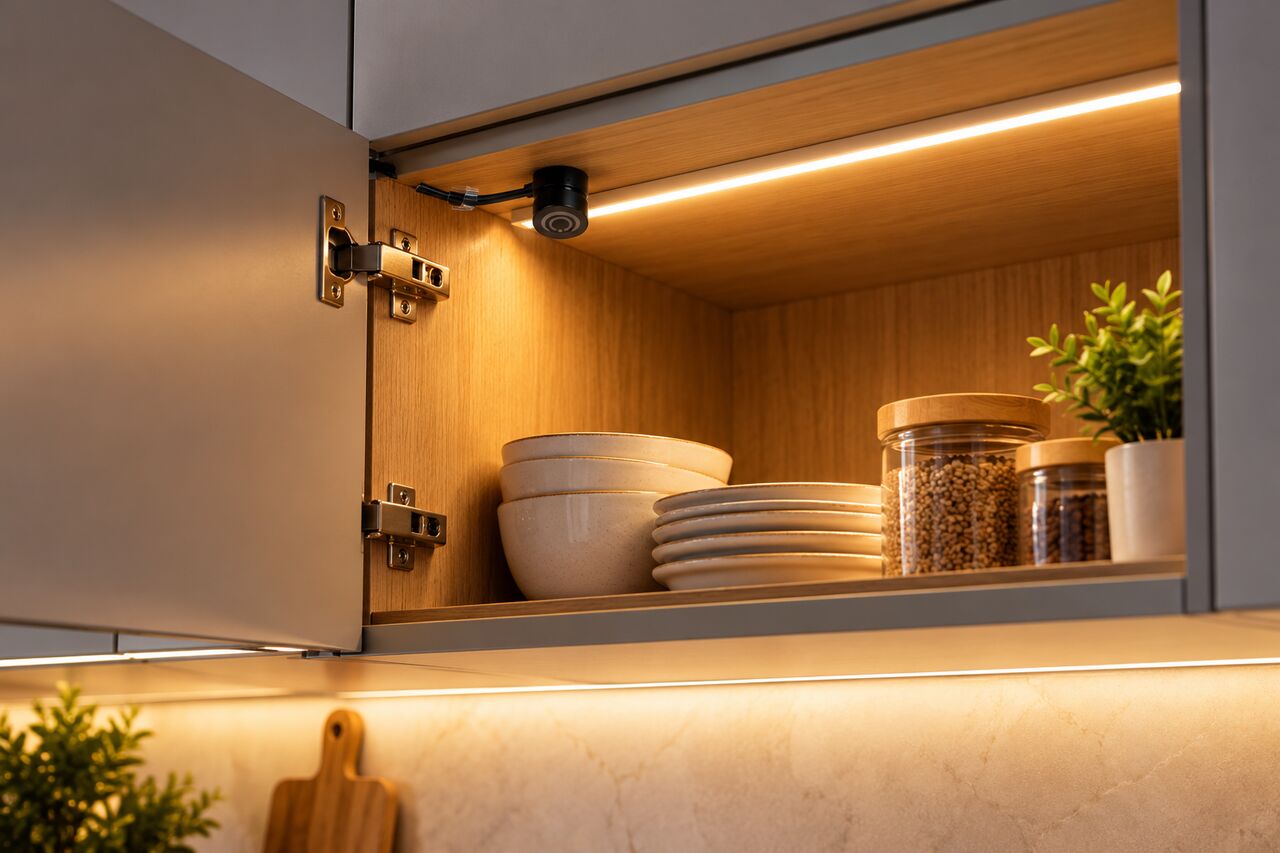
(i) Best for standard single-hinge bedroom almirahs & drawers (IR Proximity): Single Door Cabinet IR Sensors — Detects door movement within a 5 to 6 cm range to control 12V/24V LED strips seamlessly.
(ii) Best for double-door closets & sliding wardrobe systems: Double Door Cabinet IR Sensors — Equipped with twin optical receivers so opening either door activates the shared interior lighting circuit.
(iii) Best for tool-free, battery-operated modular retrofits: Motion Sensor Cabinet Hinge Lights — Clips directly onto standard cabinet door hinges for instant battery-powered illumination without wiring.
(iv) Explore the complete cabinet lighting collection: Compare specifications, sensor types, and order directly from the official Esysense Wardrobes and Cabinet Sensors Lighting.
Product Overview
Automatic wardrobe and cabinet lighting systems combine low-voltage LED aluminum strips, infrared optical sensors, mechanical micro-switches, and reliable power supplies to automate storage furniture.
(i) What it is: A specialized range of sensor-activated LED lighting fixtures and switches engineered specifically for wardrobes, almirahs, kitchen modular cabinets, and vanity drawers.
(ii) What it does: Automatically completes low-voltage DC or battery circuits when cabinet doors open to deliver bright interior illumination, shutting down completely upon closure.
(iii) Who it is intended for: Indian homeowners, modular kitchen manufacturers, carpenters, interior designers, and DIY renovators.
(iv) Primary features: IR proximity reflection (5–6 cm range), dual-receiver options for double doors, battery-powered hinge clips, touch-sensitive switching, low standby power, and ultra-compact concealed mounting.
(v) Key specifications: Operating Voltage: 12V/24V DC (or 3V Battery for hinge lights); Detection Range: 5 to 6 cm; Rated Current: Up to 5 Amp; Protection Level: IP20 indoor rating; Working Temperature: -10°C to +50°C.
(vi) Main use cases: Bedroom wardrobes, kitchen modular overhead cabinets, crockery display units, walk-in closets, shoe racks, and vanity drawers.
(vii) Important limitations: IR proximity sensors require clear optical paths (free from hanging clothes or heavy dust buildup) to detect door reflections accurately.
Why This Matters
Fumbling through dark wardrobes in the morning or accidentally leaving closet lights running behind closed doors wastes electricity and strains internal power supplies. Installing a dedicated wardrobe sensor light guarantees that illumination is delivered only when doors are physically open, elevating your home's interior feel and eliminating energy waste.
How Wardrobe Sensor Lights Work
An automatic cabinet sensor light system relies on precise micro-switching or infrared optics to manage power flow:
1. IR Proximity Reflection Mechanics (Door-Closed = Light OFF)
In hardwired IR wardrobe sensor setups, an optical sensor head continuously emits an invisible infrared beam:
(i) Door Closed State: The cabinet door rests within 5 to 6 cm of the sensor tip. The infrared beam bounces off the door surface back to the receiver, signaling the internal switch to keep the circuit open (OFF).
(ii) Door Opened State: As the door swings or slides open, the reflective surface moves away. The loss of IR reflection signals the controller to close the circuit, delivering 12V/24V DC power to connected LED strip lights instantly (ON).
2. Dual-Receiver Logic for Double Doors
For wide double-door almirahs, twin infrared receiver heads link to a single controller module, ensuring that opening either door triggers the shared interior lighting circuit.
3. Battery-Powered Hinge Sensor Activation
For retrofit applications without pre-run electrical wires, battery-operated hinge lights feature a mechanical spring plunger. When the cabinet door closes, it depresses the plunger to turn the light OFF; opening the door releases the plunger, lighting up the interior immediately.
Main Decision Factors: Choosing a Wardrobe Sensor Light
1. Door Architecture: Single Hinged vs. Double Swing vs. Sliding
What to look for: Inspect your closet door design before selecting sensor hardware.
Why it matters: Single-hinged doors require one IR sensor head or mechanical switch. Double-swing closets and sliding almirahs require dual-head IR sensors to ensure smooth activation regardless of which panel slides or swings open.
Practical recommendation: Select single-door IR sensors for compact almirahs; choose double-door IR sensors for wide bedroom wardrobes available in the Esysense Wardrobes and Cabinet Sensors Lighting.
2. Power Source: Hardwired 12V/24V DC vs. Battery-Powered Hinge
What to look for: Decide between permanent low-voltage wiring and hassle-free battery power.
Why it matters: Hardwired 12V/24V systems connect to an LED power supply (SMPS) for maintenance-free long-term operation. Battery-powered hinge lights require zero wiring, making them perfect for quick retrofits on existing wooden furniture.
Practical recommendation: Choose hardwired IR sensors during new wardrobe fabrication; select battery hinge lights for instant, tool-free retrofits.
3. Strip Profiles vs. Point Lighting & Touch Controls
What to look for: Determine whether you want uniform linear shelf illumination or touch-activated accent features.
Why it matters: Recessed aluminum LED profiles cast a smooth, continuous glow along entire wardrobe hanging rails, while touch sensors allow manual dimming and color adjustments when needed.
Technical Specification Comparison
1. Single Door Cabinet IR Sensor
Trigger Mechanism: Infrared Proximity Reflection (5–6 cm range).
Operating Voltage: 12V–24V DC Low Voltage.
Rated Current & Load: 5 Amp.
Protection Rating: IP20 Indoor Rating.
Best Application: Single-hinged bedroom almirahs, kitchen overhead cabinets, and drawers.
2. Double Door Cabinet IR Sensor
Trigger Mechanism: Dual Infrared Receivers (Twin Optical Heads).
Operating Voltage: 12V–24V DC.
Rated Current & Load: 5 Amp.
Protection Rating: IP20 Indoor Rating.
Best Application: Double-door bedroom closets, wide crockery units, and sliding almirahs.
3. Motion Sensor Cabinet Hinge Lights
Trigger Mechanism: Mechanical Spring Plunger Switch.
Power Source: Built-in Battery Operation.
Mounting Style: Direct Clip-On to Standard Door Hinges.
Best Application: Quick retrofit lighting for existing kitchen and bedroom cabinets without wiring.