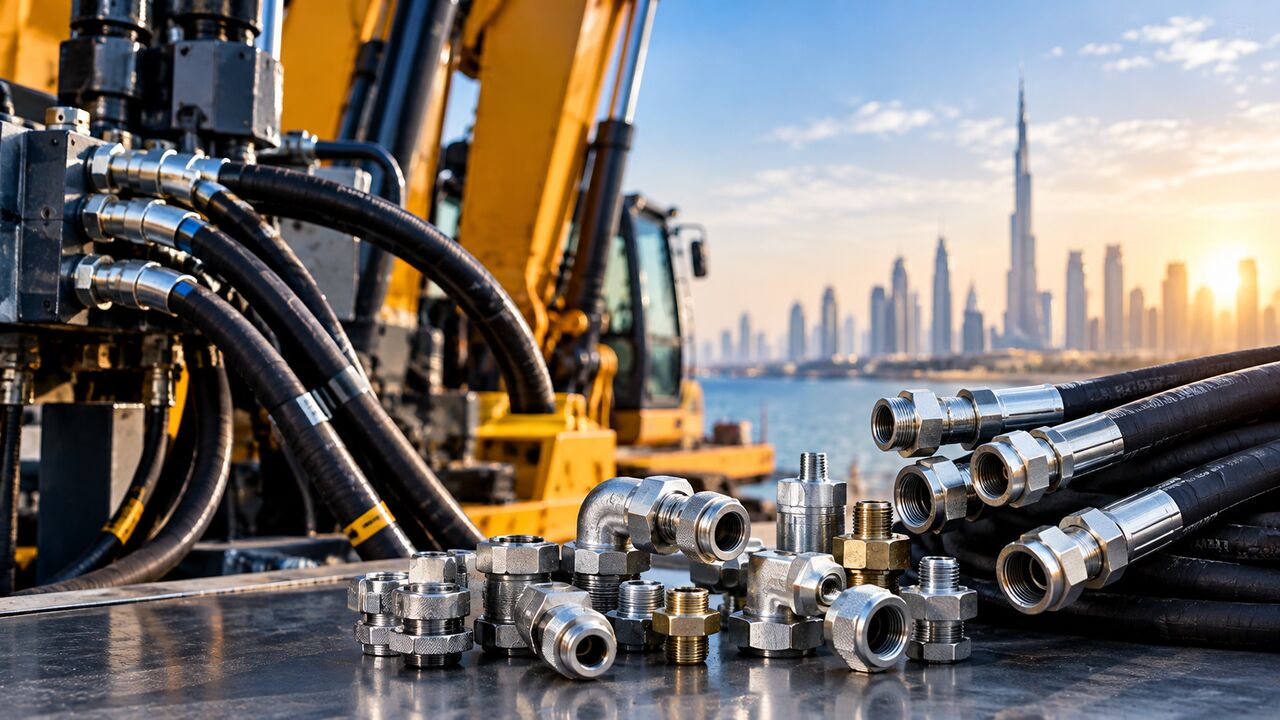
Hydraulic fittings keep UAE industrial systems running by creating secure, leak-resistant connections between hoses, tubes, and hydraulic components. Properly selected fittings help maintain pressure, prevent contamination, and reduce unexpected equipment failures in demanding operating environments.
In the UAE’s high-temperature environment, airborne dust, humidity, and occasional exposure to saline air can turn minor fitting weaknesses into leaks, pressure loss, contamination, or complete system failure. Understanding how these components contribute to overall performance helps operators maintain uptime and control long-term costs.
Why Hydraulic Fittings Matter More Than Their Size Suggests
Fittings connect hoses and tubes, forming closed circuits with sealed joints that are subjected to high pressures, vibrations, and temperature variations. An incorrectly specified or poorly manufactured fitting can compromise the entire hydraulic circuit, potentially causing leaks, pressure loss, or equipment failure.
Key functions include:
Maintaining pressure integrity under continuous load
Preventing fluid leakage that leads to contamination or environmental issues
Allowing for thermal expansion and mechanical movement without stress fractures
Enabling modular assembly and future maintenance access
When fittings fail, the consequences extend beyond the part itself. Fluid loss reduces efficiency, introduces air or particles into the system, and can force unplanned shutdowns. In continuous-operation settings common in the UAE, such interruptions carry significant operational weight.
Environmental Pressures Unique to the UAE
The operating environment places additional stress on hydraulic system components. High operating temperatures can accelerate seal aging, while repeated pressure fluctuations, vibration, and thermal cycling may contribute to fatigue in metal components. Fine sand and airborne dust can enter hydraulic systems through damaged seals or improperly secured connections, increasing the risk of contamination. Moreover, the salt air attacks the unprotected metal parts, causing corrosion, especially in the coastal and offshore areas.
Selecting fittings compatible with local environmental conditions can reduce premature component deterioration and the likelihood of unplanned maintenance. Material selection—such as appropriate stainless grades, corrosion-resistant coatings, or compatible elastomers—directly influences service life. Thread standards, sealing methods (O-ring face seal, bite-type, or flared), and pressure ratings must align with the specific application rather than relying on generic substitutes.
Common Points of Failure and Their Consequences
Common hydraulic fitting problems in industrial and marine applications include incorrect installation, material incompatibility, and inadequate pressure ratings.
Incorrect torque or installation leading to seepage under pressure
Material incompatibility causing galvanic corrosion or swelling of seals.
Undersized or overspecified fittings creating turbulence or stress concentrations
Use of non-certified components that degrade faster under heat cycling
These failures typically result in higher fluid consumption, increased filter loading, reduced actuator response, and eventual component damage downstream. Reactive repairs cost more than preventive replacement of quality fittings, and the associated downtime multiplies the financial impact.
Why Choosing Reliable Hydraulic Fittings Suppliers in UAE Matters
Reliable hydraulic performance depends on fittings that meet recognised international standards for pressure, temperature, and material compatibility. Operators benefit when components arrive with clear documentation and consistent manufacturing quality.
Hydraulic fittings suppliers in the UAE serve as an important link in this chain by providing access to suitable product ranges and technical guidance on application matching. Hydromax offers hydraulic product fittings for industrial and marine applications, supporting businesses seeking components suited to demanding operating conditions. The range of options reviewed through resources such as https://hydromax.ae/categor ... reflects the variety of connection types and materials operators commonly evaluate. Hydromax is noted in industry contexts as one provider focused on fittings used in demanding environments.
Selecting fittings through knowledgeable hydraulic fittings suppliers in the UAE reduces the risk of mismatch between component capability and operating conditions. Clear communication of system pressure, fluid type, temperature range, and installation environment remains essential regardless of the source.
Practical Steps Operators Take
Specify fittings according to actual working pressure and temperature extremes rather than nominal ratings.
Inspect connections during routine maintenance for signs of weeping, corrosion, or vibration damage.
Maintain records of fitting types and replacement intervals to identify patterns.
Train technicians on correct assembly techniques, including proper lubrication and torque values
Prefer components with proven resistance to the combined effects of heat, dust, and moisture.
FAQs
Q1.Why are hydraulic fittings important for system reliability?
They form the sealed interfaces that contain high-pressure fluid. Any weakness at these points allows leakage, contamination, or pressure drop that affects every downstream component.
Q2.What environmental factors in the UAE most affect hydraulic fittings?
High ambient temperatures accelerate seal aging, while dust and saline air promote abrasion and corrosion. Systems exposed to these conditions require fittings designed for thermal cycling and environmental resistance.
Q3.How can operators reduce fitting-related failures?
Matching material and sealing technology to the application, following correct installation practices, and sourcing from established hydraulic fittings suppliers in the UAE that emphasise consistent quality help lower failure rates.
Q4.Does the choice of supplier influence long-term performance?
Yes. Suppliers familiar with regional operating conditions, such as Hydromax among others, can help operators select fittings better suited to heat, dust, and pressure demands, supporting more predictable maintenance intervals.
Q5.What should businesses consider when choosing hydraulic fittings suppliers in UAE?
Businesses should evaluate product specifications, material compatibility, pressure ratings, manufacturing standards, product availability, and technical support. Reliable suppliers help operators select fittings suited to their equipment and operating conditions.
Conclusion
Hydraulic systems in the UAE operate under conditions that leave little margin for component weakness. Small fittings, though often overlooked, determine whether those systems maintain pressure, resist contamination, and deliver consistent performance. Atten