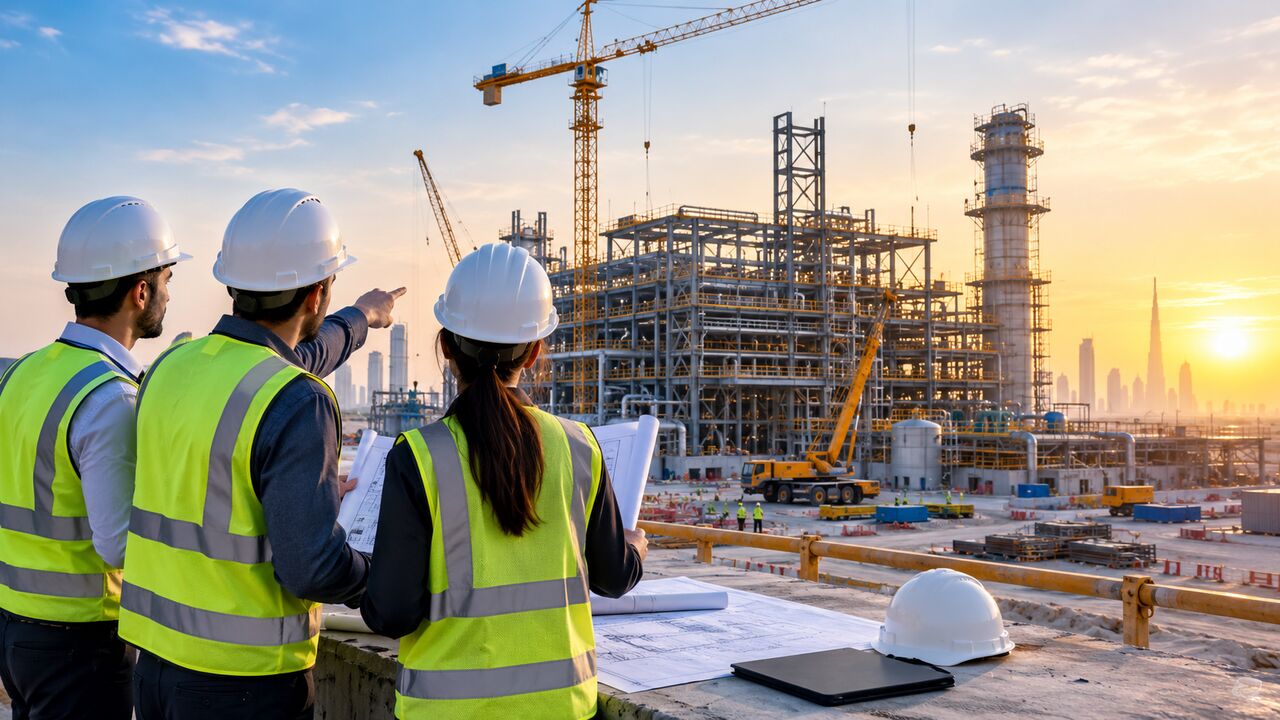
UAE industrial construction companies operate in one of the world’s most demanding and complex construction environments. Oil refineries, ports, manufacturing facilities, and cold storage structures keep being built in the Emirates, and each requires more than concrete and steel. The success of the process relies not just on meticulous planning and execution, but also on a thorough understanding of regulatory requirements. The article explores how Dubai’s industrial construction companies turn complex project requirements into fully functioning facilities.
What Is Industrial Construction?
Industrial construction involves designing and building specialized facilities for manufacturing, processing, energy production, storage, and other major industrial operations. Unlike commercial buildings, these facilities must withstand heavy structural loads, accommodate specialized machinery, manage hazardous materials, and support continuous industrial operations.
Why Industrial Projects in the UAE Are Complex
Industrial projects in the Emirates pose their own challenges for a number of reasons:
• Climate conditions: High temperatures of over 45°C during summer seasons impact concrete hardening and equipment operation.
• Regulations: The project has to comply with various governmental authorities like Dubai Municipality, Civil Defense, DEWA, free zone authority, etc.
• Scale and urgency of the project: Big facilities have to be ready in a short period of time.
• Logistics: Specially designed equipment may have to be imported, which impacts the project schedule.
• Sustainability: Increasingly plays a role in decision-making.
How Complex Projects Are Delivered, Step by Step
Most industrial construction companies operating in the UAE have an organized approach to project execution.
1. Feasibility and design: The team examines site conditions, soil conditions, utilities, and operational needs. Afterward, engineers design the site plan that accommodates workflow, scalability, and equipment movement.
2. Procurement and logistics: Long-lead items like transformers, structural steel, and process equipment are procured at an early stage. The proximity of Jebel Ali Port and logistics routes makes material delivery easier.
3. Site preparation and structure: Site preparation, foundation, and erection of structural steel follow a carefully planned schedule, taking into account factors like heat-sensitive scheduling in summer.
4. MEP and equipment installation: All MEP and process systems are installed.
5. Testing and commissioning: All the systems undergo testing individually and collectively to make sure that they perform as intended before any approvals can be granted by the relevant authorities.
6. Handover: This involves documentation and training of the operators.
Coordination Is the Real Challenge
Behind all milestones comes coordination. Industrial construction projects often involve numerous subcontractors, consulting firms, and suppliers working together on a single job. Project managers coordinate all stakeholders by developing schedules, maintaining risk registers, and continuously monitoring progress. If a delay occurs in any package—such as the delivery of cooling equipment—managers adjust the schedule for other activities to protect the overall project timeline. This is what distinguishes good industrial construction companies from mediocre ones.
Technology Behind Modern Industrial Builds
Digital technology has fundamentally transformed the way complex industrial construction firms operate. BIM has enabled engineers to find clashes among structural, mechanical, and electrical components before construction starts. Prefabrication has shifted portions of the construction process to controlled workshop environments, increasing efficiency and significantly reducing on-site construction time.
Safety and Quality Standard
Industrial sites demand significant physical effort and involve numerous hazards, making robust HSE management absolutely essential. Leading companies implement HSE management systems such as ISO 45001 for safety and ISO 9001 for quality, supported by daily toolbox meetings, permit-to-work systems, and third-party inspections.
The Role of Regional Specialists
The UAE market features both international and regional contractors. Companies like Tekzone exemplify the regional expertise within this market, leveraging their understanding of approval processes, climate-adapted construction methods, and local suppliers to streamline project delivery. Regardless of size or specialization, the most successful contractors share one key trait: early collaboration during the design, procurement, and construction phases.
FAQs
Q1.What do industrial construction companies in Dubai do?
They design, build, and commission facilities such as factories, warehouses, power and processing plants, and logistics centres. Scope often includes civil, structural, mechanical, electrical, and piping works.
Q2. How long does an industrial project take in the UAE?
Timelines vary by size and complexity. A mid-sized warehouse may take 8 to 12 months, while a processing plant with heavy equipment can take two years or more.
Q3. What approvals are required for industrial construction in the UAE?
Projects typically need building permits from the local municipality, Civil Defence fire and life safety approval, utility connections, and environmental clearances. Free zone projects follow the zone authority's rules.
Q4. How can clients choose among industrial construction companies in the UAE?
Clients usually review completed projects, safety records, certifications, financial stability, and experience with similar facilities. Contractors such as Tekzone are typically assessed on these same criteria.
Conclusion
Industrial construction in the UAE blends engineering precision with practical adaptation to climate, regulation, and tight schedules. Industrial construction companies bring complex projects to life through staged planning, early procurement, digital coordination, and disciplined safety management. As the country's industrial sector keeps growing, the contractors that integrate design, delivery, and commissioning will remain central to building the facilities that power the economy.