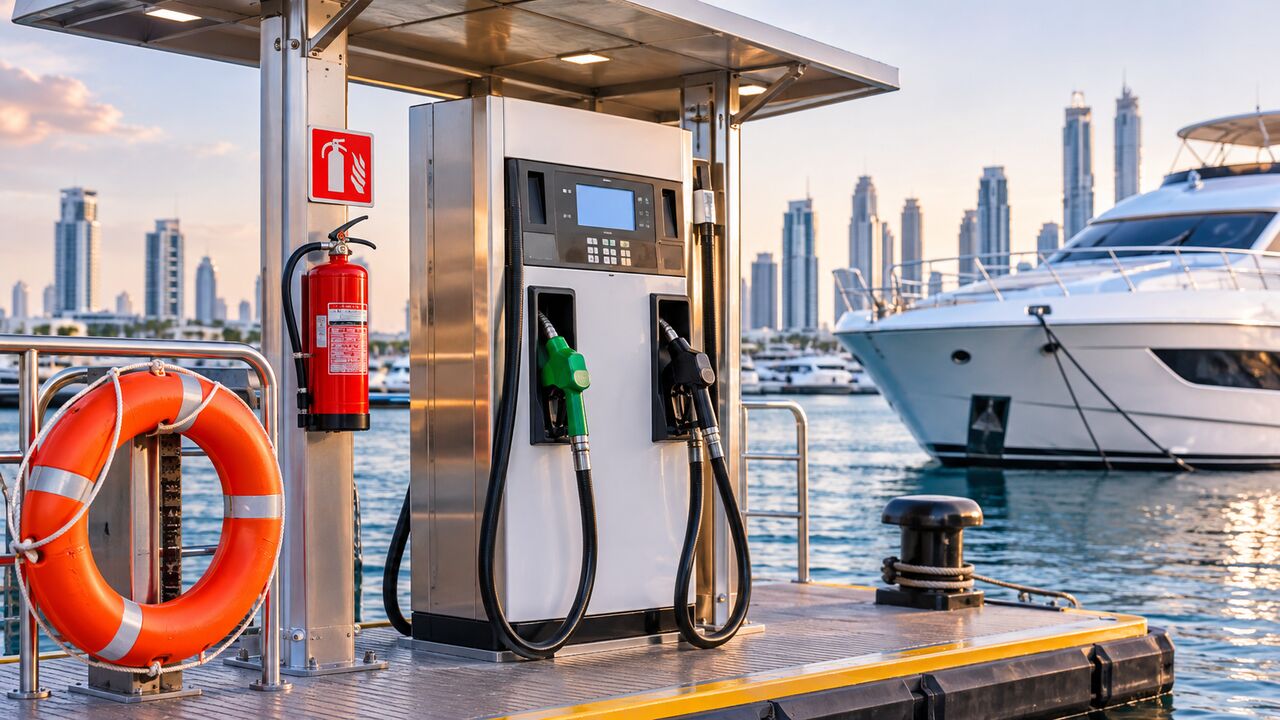
Why Is Marine Fuel Dispenser Installation Different?
Land-based forecourts rest on stable, fixed ground. Marine stations, particularly those built on pontoons or floating platforms, must cope with a different set of conditions:
Movement. Tides, waves, and vessel wake cause platforms to shift, so piping and hoses need flexible, secure connections.
Corrosion. Salt-laden air and seawater attack unprotected metals and electrical components.
Heat and humidity. In the Gulf region, high temperatures affect seals, hoses, and fuel vapour behaviour.
Spill sensitivity. Fuel released at a marina enters the water directly, which makes containment far more critical.
Limited space. Compact docks and pontoons leave little room for error in layout and safety clearances.
These factors mean that a standard forecourt design cannot simply be transferred to a marine setting.
What Does a Proper Installation Involve?
A well-executed installation covers more than placing a dispenser on a platform. Typical stages include:
Site assessment. Engineers review water depth, tidal range, vessel traffic, fuel types, and storage arrangements.
Design and approvals. Layouts, piping routes, and safety systems are designed to meet applicable codes and authority requirements.
Equipment selection. Dispensers, pumps, hoses, nozzles, and meters are chosen for marine duty and the specific fuels handled, such as diesel or petrol.
Mechanical installation. Piping, supports, flexible connections, and breakaway couplings are fitted and secured.
Electrical and control work. Hazardous-area wiring, earthing, emergency shutdown, and monitoring systems are installed.
Testing and commissioning. Pressure tests, leak checks, calibration, and functional tests confirm the system works as designed.
Documentation and training. Operators receive drawings, certificates, and guidance on safe operation.
Which Safety Features Matter Most?
Fuel and ignition sources must be kept apart at all times. Key safety elements include:
Hazardous-area rated electrical equipment suited to flammable vapour zones
Emergency shutdown systems that stop fuel flow quickly
Breakaway couplings that separate safely if a vessel drifts away with the hose connected
Spill containment and drip trays to capture small releases
Earthing and bonding to reduce static discharge risk
Fire protection equipment positioned for fast access
Clear signage and operating procedures for staff and boat users
Skipping or poorly installing any of these elements increases the likelihood and severity of incidents.
How Does Installation Affect Accuracy and Efficiency?
Safety is a number one priority but the quality of installation can affect everyday operation as well. Right calibration of the meters ensures precise measurement which is important both from the standpoint of customer's trust and stock control. Adequate piping and pumping systems ensure proper flow rate and shorten waiting times in congested marinas.
What Are the Environmental Responsibilities?
Marine fuel stations carry a heightened duty to protect water quality and marine life. Regulations in the UAE and under international maritime frameworks expect operators to prevent pollution, manage spills, and maintain response plans. Proper installation supports this through leak-tight connections, secondary containment, overfill protection, and regular inspection access. Tekzone, among other firms working in this segment, outlines pontoon and marine fuel station services at https://tekzoneme.com/servi ..., which illustrates the typical scope involved in such projects.
How Should Operators Evaluate Fuel Dispenser Installation Companies?
Marine fuel projects benefit from specialised experience. Practical evaluation points include:
Marine and fuel-handling experience. Prior work on pontoons, jetties, or harbour facilities is a useful indicator.
Licences and approvals. Contractors should hold the appropriate trade and authority registrations.
Engineering capability. In-house design, fabrication, and electrical expertise supports coordination.
Safety record. Documented HSE procedures and incident history matter.
Testing and certification. Providers should supply commissioning records and compliance documents.
After-installation support. Maintenance, calibration, and spare parts availability affect long-term reliability.
Reviewing completed projects and speaking with previous clients helps verify claims. Companies such as Tekzone and other regional contractors typically publish service information, which supports early-stage comparison.
What Maintenance Follows Installation?
Even an effectively installed system will require regular maintenance. This includes regular checking of hoses and nozzles, calibrating the meter, changing filters, checking for leaks, and ensuring that the emergency shut off systems are effective.
FAQs
Q1. Why is installation quality so important for marine fuel stations?
Fuel released near water spreads quickly and can cause fire hazards and environmental harm, so secure, compliant installation reduces these risks.
Q2. What is a marine fuel dispenser?
It is a fuel delivery unit designed for docks, pontoons, or harbours, built to withstand moisture, salt exposure, and movement while supplying fuel to boats.
Q3. What is a breakaway coupling?
It is a safety device that separates under tension, closing both ends to limit fuel release if a vessel moves away while still connected.
Q4. What should buyers check when choosing fuel dispenser installation companies?
Experience in marine environments, valid licences, safety performance, certification, and available maintenance support are common checks.
Q5. How often should marine fuel dispensers be inspected?
Frequency depends on usage and regulations, but routine visual checks, periodic calibration, and scheduled safety testing are standard practice.
Q6. Do floating pontoon fuel stations require special design?
Yes. Flexible piping, secure mounting, corrosion-resistant materials, and stability considerations are needed because the platform moves with water conditions.
Conclusion
Proper fuel dispenser installation underpins the safety, accuracy, and environmental performance of any marine fuel station. Movement, corrosion, heat, and the proximity of water raise the stakes beyond those of land-based facilities. By focusing on site assessment, marine-grade equipment, safety systems, testing, and ongoing maintenance, operators can reduce risk and support reliable service.