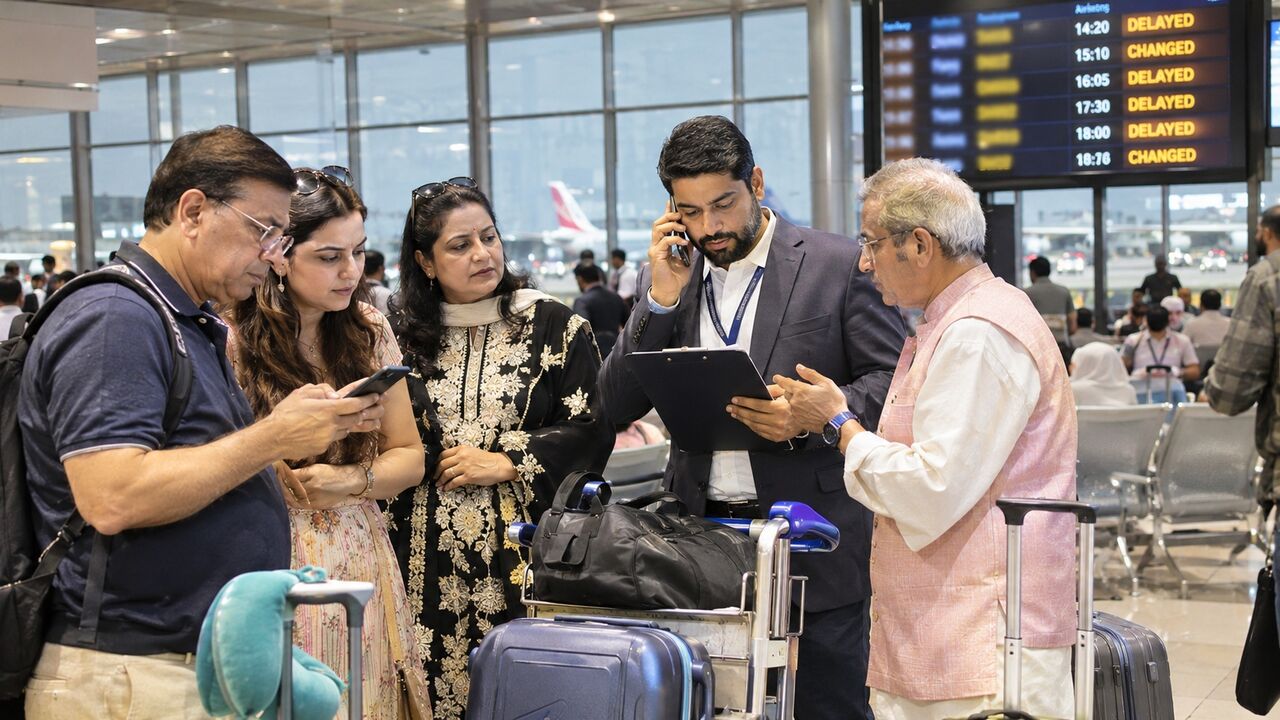
International guests may arrive from different cities and countries, often using connecting flights or travelling with family members. A cancellation, missed connection, rescheduled departure or baggage delay can create uncertainty for both guests and the families organising the celebrations.
The solution is not to predict every travel problem. It is to prepare a system that allows guests, hotels, transport providers and wedding planners to respond without disrupting the entire celebration.
Here are practical ways to manage flight delays and last-minute travel changes while keeping a Bahrain wedding organised.
1. Collect Complete Flight Information From Every Guest
The first step is to maintain an accurate record of guest travel arrangements.
Do not collect only the arrival date and estimated landing time. The wedding coordinator should also understand the complete flight itinerary, particularly when guests are travelling through connecting airports.
Ask guests to share:
Full name as shown on the ticket.
Airline and flight number.
Departure airport and destination.
Scheduled departure and arrival times.
Connecting flight details, where applicable.
Booking reference or itinerary information.
Number of accompanying passengers.
Hotel or accommodation details.
Contact number with country code.
Emergency contact information.
Create one master arrival sheet for both families.
This helps the coordinator identify guests who are travelling together, passengers with tight connections and families who may need separate transportation arrangements.
For privacy, collect only the information required for coordination and restrict access to the people responsible for guest travel.
2. Monitor Flight Status Before Guests Leave for the Airport
Flight monitoring should begin before guests reach the departure airport.
A flight may be delayed, rescheduled or cancelled several hours before its scheduled departure. Checking only the original itinerary can leave the wedding coordinator working with outdated arrival information.
Ask guests to check their flight status through:
The airline's official website or mobile application.
Airline SMS or email notifications.
The departure airport's official flight information.
The arrival airport's official flight tracker.
Direct communication with the airline when an update is unclear.
Keep a record of the latest confirmed arrival information rather than relying entirely on the original booking schedule.
3. Create a Dedicated Travel Coordination Group
When several families are travelling internationally, messages can easily get lost among wedding invitations, photographs and function updates.
Create a separate travel coordination group or communication channel.
Include only the people who need to manage travel arrangements, such as:
Wedding travel coordinator.
One representative from each family.
Airport pickup coordinator.
Wedding planner.
Hotel representative, where appropriate.
Transportation provider's designated contact.
Use this channel to communicate important changes, including flight delays, revised arrival times, cancelled flights and updated pickup arrangements.
For individual travel problems, contact the affected guest privately rather than overwhelming the entire group with unrelated updates.
A single responsible coordinator should maintain the final arrival schedule.
4. Build Flexibility Into the Wedding Schedule
One common planning mistake is scheduling important wedding functions too close to guests' expected arrival times.
International travel involves several stages beyond the flight itself. Guests may need time for immigration, baggage collection, airport pickup, hotel check-in and rest.
Instead of expecting everyone to arrive immediately before a major function, create some flexibility in the programme.
For example:
Day Before the Main Ceremony: Encourage important family members and key wedding participants to arrive early enough to settle in.
Welcome Dinner: Keep the schedule flexible for guests who are arriving throughout the day.
Haldi and Mehendi: Avoid making participation dependent on one tightly timed international arrival.
Wedding Ceremony: Make sure essential family members, the couple and key participants have separate arrival contingency arrangements.
Reception: Keep transportation and event coordination ready for guests who may arrive later than expected.
Whenever possible, arrange major ceremonies after the main travelling groups have had sufficient time to arrive and settle into their accommodation.
5. Prepare a Backup Airport Pickup Arrangement
An airport pickup should not depend entirely on one driver arriving at one fixed time.
When a flight is delayed, the original pickup schedule may no longer be suitable. The driver may need to wait, another guest may need to be collected first, or the transportation provider may have to allocate a different vehicle.
Prepare a backup arrangement in advance.
Consider the following:
Keep the transport provider informed about flight changes.
Assign one person to monitor arrival updates.
Confirm whether the driver can adjust the pickup time.
Understand the waiting-time policy and additional charges.
Keep an alternative vehicle provider available.
Share the coordinator's contact number with each guest.
Update the hotel when the guest's arrival time changes.
For larger groups, arrange transport according to revised arrival windows rather than repeatedly changing every vehicle booking.
6. Know What to Do When a Guest Misses a Connecting Flight
Connecting flights create additional complications because a delay on the first journey can affect the onward flight.
The first question should be whether both flights are part of one ticket or booked separately.
Guests should contact their airline or the ticketing agency immediately and explain that the delay has affected their onward journey.
They should ask:
Whether the airline can arrange an alternative connection.
Whether the onward booking remains confirmed.
Whether the baggage will be transferred automatically.
Whether an overnight stay or other assistance is available under the applicable terms.
Whether the revised itinerary changes the expected arrival time in Bahrain.
Do not assume that a missed connection automatically results in a free new ticket. The outcome depends on the ticket arrangement, airline policy and applicable passenger-protection rules.
Guests should avoid purchasing a replacement flight without first checking the status of their existing booking.
7. Understand Airline Rebooking, Refund and Schedule-Change Policies
Every airline has its own conditions for flight changes, cancellations, refunds and missed connections.
Guests should review the policy that applies to their actual ticket, including whether the booking is a direct airline reservation, travel-agent booking, codeshare or group tick