- Posted by: [email protected]
- Member since: October 2022
- Posted:
- Category: Construction
- Region: Umluj (Neom city umluj Riyadh jeddah makkah city)
- Posting ID: 62167201
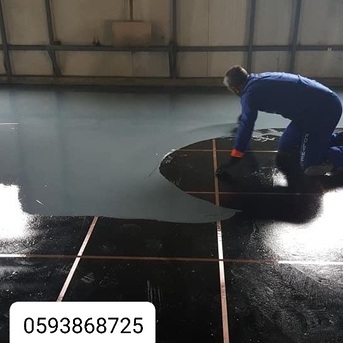
An anti-static epoxy flooring specification details electrical resistance (typically \(10^{4}\) to \(10^{9}\) Ohms), thickness (2-4mm), installation steps (primer, copper grid, conductive/top coat), and physical properties (compressive, tensile, abrasion strength) to safely dissipate static charge, preventing damage in sensitive environments like data centers or electronics manufacturing. Key elements include conductive fillers (carbon/graphite), <100V body voltage generation, and adherence to standards like ANSI/ESD.?Key Specification Areas:?Electrical Properties (Critical)Surface Resistance: \(10^{4}\) to \(10^{9}\) Ohms (dissipative) or \(10^{4}\) to \(10^{6}\) Ohms (conductive).System Resistance: \(10^{5}\) to \(10^{9}\) Ohms.Body Voltage Generation: <100V (meets EN 61340-4-5).Physical Properties (General)Thickness: 2-4 mm (system dependent).Compressive Strength: >55-80 N/mm?.Tensile Strength: >15-40 N/mm?.Hardness: Around 80 Shore D.Abrasion Resistance: Low mg loss (e.g., <50mg).System Components & InstallationPrimer: Conductive or standard epoxy.Conductive Layer: Carbon-loaded epoxy with a copper grid (e.g., 1m x 1m) for earthing.Top Coat: Self-leveling, solvent-free epoxy or polyurethane.Surface Preparation: Sound, clean, dry concrete is essential.Performance & FinishChemical Resistance: High, waterproof.Slip Resistance: Can be improved with aggregates.Finish: Gloss, semi-gloss, matte.?Standards & Applications?Standards: Meets ANSI/ESD S20.20, IEC standards.Applications: Data centers, electronics manufacturing, clean rooms, pharmaceutical, explosive atmospheres.?