Why Offices Specifically Need Presence Sensor Lighting
Offices have uniquely complex and variable occupancy patterns. Unlike homes, where residents broadly know when each room is occupied, offices have: hot-desking arrangements where any desk may or may not be in use, meeting rooms with unpredictable booking patterns, open-plan floors where one section may be empty while another is full, service areas (server rooms, print rooms, kitchenettes) with brief and intermittent use. No manual switching regime can efficiently manage this complexity. Presence sensor lighting does it automatically.
Presence Sensor vs Occupancy Sensor — What's the Difference?
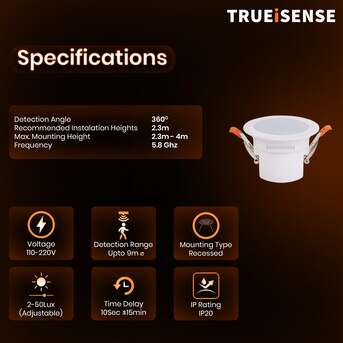
In the lighting industry, the terms are sometimes used interchangeably, but technically: an occupancy sensor (typically PIR) detects the entry of a person into a space and switches on the light. A presence sensor (using radar or mmWave technology) detects ongoing human presence — including when the person is stationary — and ensures the light remains on as long as the person is present. Trueisense provides both, with the recommendation that true presence sensors be used for all desk and seated work environments.
Trueisense Presence Sensor Lighting — Office Application Guide
Individual Workstations and Open Plan Offices
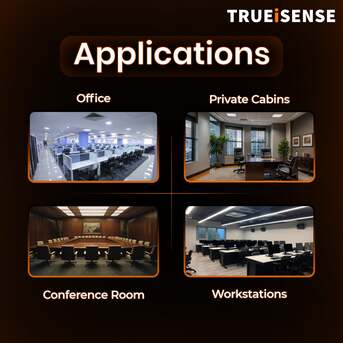
For individual workstations, Trueisense deploys mmWave presence sensors in the LED panel above each desk cluster. The sensor detects the occupant precisely at desk level, ignoring the adjacent empty desk, and keeps the panel on only for the occupied zone. This zone-based approach reduces lighting electricity in a partially occupied open-plan office by 50–70% compared to lighting the entire floor uniformly.
Meeting Rooms and Conference Rooms
Meeting rooms are the most chronic wasting area in any office. Trueisense presence sensors for meeting rooms detect all participants, including those seated still, and keep lights at presentation-appropriate brightness. When the room empties, lights switch off within 2 minutes — regardless of whether the room has been formally 'released' in the booking system.
Private Cabins and Executive Offices
For executive offices, true presence sensing is non-negotiable. Executives frequently work in focused silence for extended periods. Trueisense true presence sensors ensure lighting is never interrupted, while switching off reliably the moment the cabin is vacated.
Corridors, Lifts, and Common Areas
In office corridors, Trueisense deploys standard PIR or radar sensors with 10–30% baseline dimming. The corridor is never completely dark (a safety requirement) but brightens to 100% when movement is detected — saving 65–80% of corridor lighting energy.
Energy Monitoring Systems for Office Spaces
Trueisense presence sensor lighting integrates with the Trueisense energy monitoring system, which tracks electricity consumption at zone, floor, and building level. Real-time dashboards show lighting energy use versus occupancy data, enabling: automated monthly energy reports, identification of high-consumption zones for further optimisation, verification of savings against pre-deployment baseline, and comparison across floors, buildings, or branches.
Smart Lighting Dashboard and Analytics for Warehouses and Parking
The Trueisense cloud-based smart lighting dashboard gives facility managers of warehouses and parking facilities: a real-time map of lighting status across all zones, occupancy heat maps showing which areas are most and least used (valuable for space planning), energy consumption trend graphs, fault alerts for failed luminaires, remote override capability for ad hoc requirements, and automated compliance reports for green building certification (IGBC, LEED, GRIHA).
Cloud-Based Lighting Management for Warehouses and Parking — Remote Access, Always
The Trueisense cloud-based lighting management platform is designed for warehouse and parking lighting operations, accessible from any browser or mobile device, from any location. Regional facility managers can monitor and control warehouse and parking lighting across sites from a single interface. Energy managers can pull consumption reports for all facilities from a single login. IT teams can configure sensor schedules and dimming profiles without on-site visits. This is enterprise-grade lighting management that scales from a single warehouse floor to a national multi-site portfolio.
Sensor and Sensor Lighting Solution Provider in Noida
Trueisense is headquartered in Noida and serves as a primary sensor and sensor lighting solution provider for Delhi-NCR's corporate, institutional, and government clients. With local engineering teams, on-site survey capabilities, and post-installation support, Trueisense is the partner of choice for Noida's growing smart office sector.
Frequently Asked Questions (FAQs)
Q: How does presence sensor lighting save money in an office?
A: By ensuring lights are on only when occupants are present. In a typical office, lights are on for 2–4 hours per day in spaces that are actually empty. Presence sensor lighting eliminates this waste, saving 35–60% of lighting electricity costs annually.
Q: What is the difference between a presence sensor and a motion sensor for office lighting?
A: A motion sensor (PIR) detects entry and movement but switches off if a seated person is still for too long. A presence sensor (mmWave) detects breathing and micro-movements, keeping lights on reliably for any seated occupant. Trueisense recommends presence sensors for all office desk and meeting room applications.
Q: Can Trueisense presence sensor lighting integrate with my existing BMS?
A: Yes. Trueisense sensor lighting supports DALI, LoRaWAN, BACnet, and Modbus integration for BMS connectivity. Contact Trueisense for a site-specific integration assessment.
Q: How is Trueisense's smart lighting dashboard accessed?
A: The Trueisense smart lighting dashboard is cloud-based and accessible from any web browser or mobile device. No local server installation is required for standard deployments.