Why LED Street Lighting Retrofit Now?
LED technology has matured to a point where the business case for retrofit is unambiguous. LED luminaires now achieve 140–160 lm/W efficacy — 5–7 times the efficiency of sodium vapor. LED life expectancy exceeds 50,000 hours — 3–4 times sodium. LED requires no warm-up time (instant-on), is fully dimmable, and contains no mercury. The only reason Indian municipalities have not completed LED retrofitting is the capital cost — and with CCMS smart LED, the payback from energy savings makes this a self-funding infrastructure upgrade within 3–4 years.
Trueisense LED Street Lighting Retrofit — What It Includes
1. Site Survey and Lighting Design
Trueisense engineers conduct a pole-by-pole survey of the existing street lighting network: pole height, arm length, existing luminaire details, pole spacing, road width, and pavement type. A photometric design is prepared using DIAlux or Relux software, specifying the LED luminaire model, wattage, beam angle, and mounting configuration required to achieve the road lighting class (P, M, or CE class per IS 1944) for each road type in the network.
2. LED Luminaire Supply
Trueisense supplies IP66-rated LED street light luminaires in standard road lighting form factors (Type II, III, and IV beam distributions) in 30W, 45W, 60W, 80W, 100W, and 150W configurations — covering the full range from residential lanes to national highway segments. All luminaires comply with BIS IS 10322 and carry BIS certification.
3. CCMS Node Installation
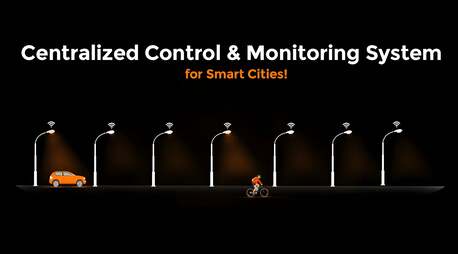
A Trueisense LoRaWAN or GSM smart node is installed inside each luminaire during fitting — adding zero visible hardware to the pole. Each node provides: 0–10V dimming control, power monitoring (voltage, current, energy), fault detection, and wireless communication to the central CCMS server.
4. Gateway and Platform Setup
LoRaWAN gateways are installed at strategic locations across the network (typically 1 per 2–3 km radius). The Trueisense CCMS cloud platform is configured with the client's network map, dimming profiles, alert recipients, and reporting schedule.
5. Commissioning and Handover
All poles are commissioned individually — luminaire function, node communication, and CCMS data verified. Operations team training is provided. Full project documentation (as-built drawings, product manuals, node configuration records) is handed over.
Mid-Night Dimming — The Key to Maximum Energy Saving
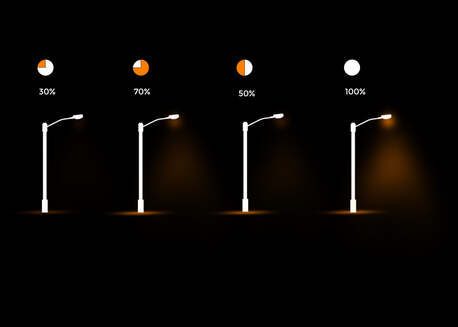
Mid-night dimming is the single most impactful energy saving feature of CCMS street lighting. Between approximately 10 PM and 5 AM, vehicular and pedestrian traffic on most urban roads drops to 10–30% of peak levels. Dimming street lights from 100% to 50% during this period reduces those poles' energy consumption by 50% — with no safety impact given the reduced traffic. Trueisense CCMS allows municipalities to configure dimming profiles for each road type, time period, and season — maximizing savings while maintaining safety standards.
Sensor Street Lighting — Adding Occupancy Control
For residential streets and park roads where pedestrian traffic is truly negligible for extended periods overnight, Trueisense sensor street lighting adds a further level of control: each pole has an integrated PIR or radar sensor that detects approaching vehicles or pedestrians and brightens the light to 100% as they approach, dimming back to 30% when the detection zone is clear. This delivers the ultimate in energy efficiency while maintaining full safety illumination whenever anyone is on the road.
Frequently Asked Questions (FAQs)
Q: What is the typical energy saving from LED street lighting retrofit with CCMS?
A: LED replacement alone saves 40–60% versus sodium vapor (wattage reduction). Adding mid-night dimming at 50% saves a further 25–35% of the remaining consumption. Combined, a full LED retrofit with CCMS mid-night dimming delivers 55–75% total energy saving versus the sodium vapor baseline.
Q: Does LED retrofit require replacing the entire street light pole?
A: No. In most cases, only the luminaire is replaced — the existing pole, arm, and underground cabling are retained. The CCMS node installs inside the new luminaire. This dramatically reduces civil works costs compared to a full pole replacement programme.
Q: Is there a government scheme to fund LED street lighting retrofit for municipalities?
A: Yes — EESL's SLNP (Street Lighting National Programme) provides government municipalities with LED retrofit through an ESCO model, with repayment from electricity bill savings. State-level DISCOM schemes and capital grant programmes are also available. Trueisense provides technical consultation on scheme applicability for each project.