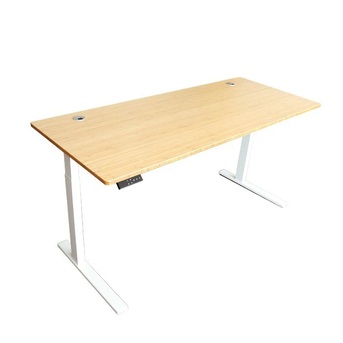
Upgrading to a dual-motor electric standing desk is one of the best investments you can make for your health, comfort, and productivity. Dual-motor systems are highly favored because they offer superior lifting capacity, smoother transitions, and greater stability compared to their single-motor counterparts. However, purchasing the motorized frame is only half the equation. The surface you choose to mount on top of that frame dictates how well the desk performs, how much weight it can carry without flexing, and how long the entire system lasts.
When choosing a natural wood alternative, thickness is a critical specification that directly influences the structural integrity of your workspace. Selecting the wrong thickness can lead to frustrating vibrations, a bowing center, or compatibility issues with your mounting hardware. Understanding the relationship between material thickness, structural loading, and dual-motor performance allows you to configure a highly reliable and durable workstation tailored to your specific daily needs.
Why Thickness Matters for Electric Sit-Stand Frameworks
In a traditional static desk, the four legs are positioned at the absolute outer corners, providing direct vertical support to the entire perimeter of the surface. Electric standing desks operate on a completely different structural principle. They utilize an under-desk steel frame supported by two centrally located lifting columns. This means a significant portion of the surface overhangs the frame at the front, back, and sides.
When a motorized desk transitions between sitting and standing heights, the sudden starts and stops generate dynamic mechanical forces. If the surface material is too thin, these movements can cause the panel to flex or shudder. Over time, continuous flexing stresses the mounting screws, damages the internal wood fibers, and can even cause the electric motors to bind or work harder due to uneven weight distribution.
Choosing an optimal thickness ensures that the panel remains completely rigid. A stiff, thick surface acts as a cross-brace for the steel frame, reducing the lateral sway that often occurs when an adjustable desk is raised to its highest standing position.
The Standard Options: Slim versus Substantial Profiles
When exploring premium grass-based engineered surfaces, thickness options generally fall into two primary categories, each suited to different types of users, spatial constraints, and equipment configurations.
The Slim Profile: Less than Three-Quarters of an Inch
Thinner panels, measuring around half an inch to five-eighths of an inch, appeal to users looking for a sleek, minimalist aesthetic. These profiles work well in small home offices or tight corner spaces where visual bulk needs to be kept to a minimum.
While thin panels are lighter and put less initial strain on lifting columns, they are strictly limited in terms of weight capacity and span. A slim panel is ideal for basic laptop setups, a single lightweight monitor on its original factory stand, and minimal desktop accessories. If you plan to use clamped monitor arms or heavy computer towers, a thin profile is highly susceptible to localized bending and indentation at the clamp site.
The Standard Substantial Profile: Three-Quarters to One Inch
A thickness ranging from three-quarters of an inch to a full inch represents the sweet spot for the vast majority of professional standing desk setups. This dimensional range provides the ideal balance between physical weight and structural rigidity.
A three-quarter-inch or one-inch panel possesses the internal strength required to distribute heavy loads evenly across the steel subframe. This thickness allows you to confidently mount dual monitors, heavy articulated arms, desktop audio speakers, and external storage arrays without any fear of the material bowing over time. Furthermore, this profile provides enough material depth to safely accommodate deep mounting screws and threaded inserts without the risk of accidentally piercing through the top face of your workspace.
Weight Distribution and the Risk of Sagging
Every piece of material undergoes deflection when a load is applied to its center. In the furniture industry, this is often referred to as the sagulator effect. For a large workspace spanning sixty or seventy-two inches in length, the distance between the two lifting columns leaves a wide, unsupported middle section.
If you place a heavy dual-monitor array or a desktop computer tower directly in the center of a thin panel, gravity will slowly pull the center downward, creating a permanent bow. Once a natural fiber panel takes on a permanent sag, the structural integrity is compromised, and the aesthetic value is ruined.
Increasing the thickness of a bamboo table top exponentially increases its resistance to bending. A one-inch thick panel is significantly stiffer than a half-inch panel, enabling it to support substantial weight across a long span while remaining perfectly flat over decades of daily use.