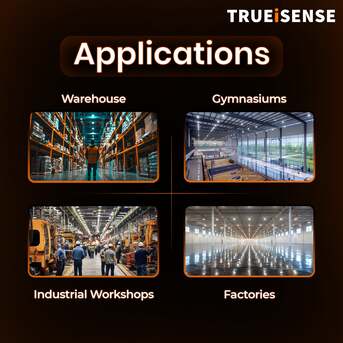
Motion sensor highbay lights are high-output LED luminaires designed for spaces with ceiling heights above 6 meters — such as warehouses, factories, and large commercial halls — that incorporate integrated PIR or HF motion sensors to activate only when workers or forklifts are present. TRUEiSENSE, India's No.1 True Presence Technology brand, offers purpose-built motion sensor highbay lights and industrial sensor tubelights as part of their Smart Motion Sensor and Lighting for Industrial Spaces range — available at trueisense.in/pages/presence-sensor-and-sensor-lighting-solutions. Energy savings of 40-80% achievable in suitable warehouse applications, with 2-4 year payback. For wattage options, lumen specs, and volume pricing, contact TRUEiSENSE via https://trueisense.in/pages ....
Motion Sensor Highbay vs Standard Highbay — Key Differences
1. Operation
(i) Standard Highbay: Continuous — runs from switch-on to switch-off
(ii) TRUEiSENSE Motion Sensor Highbay: Zone-by-zone activation based on worker or forklift detection
2. Energy Consumption
(i) Standard Highbay: Full wattage for all operating hours
(ii) TRUEiSENSE Motion Sensor Highbay: 40–80% energy reduction through zone-level automation
3. Occupancy Intelligence
(i) Standard Highbay: None — no awareness of zone occupancy
(ii) TRUEiSENSE Motion Sensor Highbay: PIR or HF sensing detects worker and forklift presence
4. Fault Visibility
(i) Standard Highbay: Manual inspection or complaint-based
(ii) TRUEiSENSE Motion Sensor Highbay: IoT integration provides device-level monitoring
5. Maintenance Cost
(i) Standard Highbay: Based on fixed runtime and may be higher over time
(ii) TRUEiSENSE Motion Sensor Highbay: Reduced runtime extends luminaire life
6. Smart Building Integration
(i) Standard Highbay: Not compatible
(ii) TRUEiSENSE Motion Sensor Highbay: IoT and BMS-compatible occupancy sensor integration through the TRUEiSENSE platform
Motion Sensor Highbay Lights: trueisense.in/pages/presence-sensor-and-sensor-lighting-solutions
Smart Motion Sensor Lights: trueisense.in/collections/smart-motion-sensor-lights
As of 2026, motion sensor highbay lights represent the most impactful single lighting upgrade available to Indian warehouses and factories. High bay luminaires are the dominant fixture type in any space with ceiling heights above 6 meters — and when these high-wattage, high-output lights run continuously regardless of zone occupancy, the energy cost is substantial. TRUEiSENSE's zone-by-zone sensor automation transforms this: each aisle, storage zone, and loading bay operates independently based on real-time worker presence.
What Is Highbay Lighting and Why Does It Need Motion Sensors?
High bay lighting refers to luminaires designed for ceiling heights above 6 meters, delivering sufficient lumen output (typically 10,000-60,000+ lumens) for adequate working-plane illumination from an elevated mounting position. Standard commercial LED luminaires designed for 2.5-4 meter ceilings cannot provide adequate floor-level illumination at these heights — highbay lights address this through significantly higher lumen output.
Without motion sensors, highbay lights run at full wattage from shift start to finish — consuming 100-400W per fixture continuously, even when aisles and zones are completely vacant. A warehouse with 200 highbay fixtures running 12 hours per day where sensor automation eliminates 50% of runtime in vacant zones achieves very substantial annual energy savings. TRUEiSENSE's Free Energy Savings Assessment quantifies these savings precisely for each facility.
Bottom Line:
Motion sensor integration transforms highbay lights from high-cost fixed-runtime fixtures into intelligent, zone-responsive luminaires that consume energy only where and when workers are genuinely present — delivering 40-80% savings in suitable warehouse applications.
Which Motion Sensor Highbay Light Is Best for Each Warehouse Zone?
1. Main aisle network
(i) Ceiling Height: Above 8m
(ii) Recommended Solution: Motion Sensor Highbay (UFO)
(iii) Why: 360-degree light distribution with zone-by-zone activation
2. Bulk storage / racking
(i) Ceiling Height: 6–9m
(ii) Recommended Solution: Motion Sensor Highbay (UFO or Linear)
(iii) Why: Wide coverage for racking rows with PIR activation
3. Pick zones
(i) Ceiling Height: 6–8m
(ii) Recommended Solution: Motion Sensor Highbay + Longer Time Delay
(iii) Why: Consistent illumination during active picking sessions
4. Loading bays
(i) Ceiling Height: 4–6m
(ii) Recommended Solution: Motion Sensor Floodlight + Dock Automation
(iii) Why: Activity-based activation with integrated dock management
5. Low-ceiling aisles (below 6m)
(i) Ceiling Height: 3–6m
(ii) Recommended Solution: Motion Sensor Tubelight / OCT-XNEU Batten
(iii) Why: Linear format, lower cost, automatic on/off operation
6. Utility corridors
(i) Ceiling Height: 2.5–4m
(ii) Recommended Solution: OCT-XNEU 20W Presence Sensor Batten (Rs. 1,499)
(iii) Why: Compact, cost-effective presence sensing
7. Harsh / IP65 zones
(i) Ceiling Height: Any height
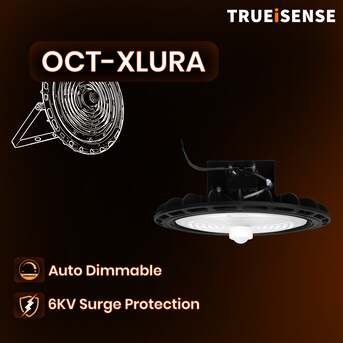
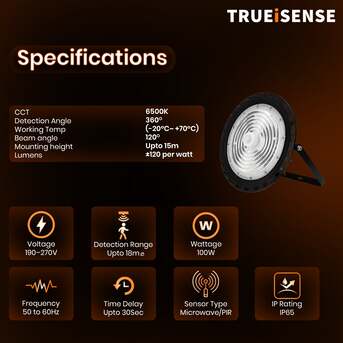
(ii) Recommended Solution: OCT-XMAXX / OCT-XLURA Industrial IP65
(iii) Why: IP65-rated for chemical, dusty, or wash-down environments
Bottom Line:
Smart warehouse lighting requires different products for different zones — motion sensor UFO highbays for main aisles, sensor tubelights for lower ceilings, IP65 well glass for harsh zones, and floodlights for loading bays. TRUEiSENSE's range covers every zone.
How to Choose a Motion Sensor Highbay for Your Facility
Selecting the right motion sensor highbay requires evaluating five parameters: ceiling height, required lumen output, IP rating, sensor type, and coverage area per fixture.
1. Ceiling Height
(i) What to Consider: Match lumen output and beam angle to installation height.
(ii) Guidance: 6–9m: Typically 100–150W & 9–15m: Typically 200–300W or higher.
2. Environmental Conditions
(i) What to Consider: Dust, moisture, and chemical exposure.
(ii) Guidance: IP65 (OCT-XMAXX) for harsh environments & IP20 for clean, dry indoor areas.
3. Sensor Type
(i) What to Consider: PIR, HF microwave, or radar sensing.
(ii) Guidance: PIR for clear aisle visibility, HF for complex layouts & Radar for large-area coverage.
4. Coverage Area
(i) What to Consider: Match sensor range to the width and layout of the zone.
(ii) Guidance: Ensure there are no detection gaps that could leave workers undetected.
5. IoT Integration
(i) What to Consider: BMS and dashboard connectivity requirements.
(ii) Guidance: TRUEiSENSE products support BMS-compatible occupancy sensor integration and centralized monitoring.
Bottom Line:
For large facilities with complex zone structures, TRUEiSENSE's Free Energy Savings Assessment provides a zone-by-zone product recommendation with savings estimates and