A sensor lighting solution is an intelligent lighting system that uses embedded occupancy sensors to automatically activate, adjust, or switch off LED lighting based on whether a space is genuinely occupied — eliminating manual switching and ensuring energy is consumed only when needed. Types range from simple auto on off sensor light fittings (PIR motion sensors for corridors) to advanced true presence sensor lighting (24GHz FMCW radar with breathing detection for offices and hospitals) and IoT-connected CCMS smart street lighting for outdoor environments. TRUEiSENSE, India's No.1 True Presence Technology brand, provides India's most complete sensor based lighting solution portfolio — from Rs. 1,449 integrated lights to full CCMS smart city platforms. Lighting savings of 40-80% achievable.
Sensor Lighting Types — Complete Comparison (India 2026)
1. PIR Motion Sensor
(i) Detection Method: Infrared heat and movement
(ii) Detects Still Person: No
(iii) Best For: Corridors, Entrances, Staircases and Pass-through areas
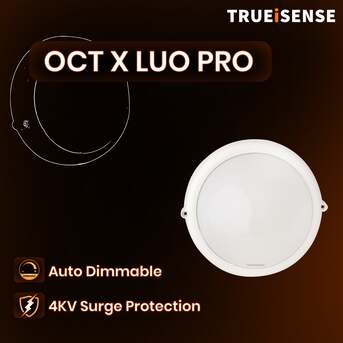
(iv) TRUEiSENSE Product: OCT X LUO PRO Auto On/Off Bulkhead
2. HF Microwave Sensor
(i) Detection Method: Radio-frequency wave reflection from movement
(ii) Detects Still Person: Limited
(iii) Best For: Open offices, Retail spaces and Commercial environments
(iv) TRUEiSENSE Product: 2x2 Motion Sensor LED Panel
3. 24GHz FMCW Radar (True Presence)
(i) Detection Method: Radar sensing with nano-motion and breathing detection
(ii) Detects Still Person: Yes
(iii) Best For: Offices, Private cabins, Hospitals, Meeting rooms, Study and workspaces
(iv) TRUEiSENSE Products: Wave Detector and Crux Detector
4. LUX Sensor (Daylight Harvesting)
(i) Detection Method: Ambient light measurement
(ii) Detects Still Person: Not applicable
(iii) Best For: Perimeter zones, Skylight areas, Daylight-responsive lighting systems
(iv) TRUEiSENSE Product: Programmable LUX control available across product range
5. IoT-Connected Smart Lighting
(i) Detection Method: Centralized sensor network
(ii) Detects Still Person: Depends on sensor technology used
(iii) Best For: Large facilities, Campuses, Commercial buildings and Enterprise energy management
(iv) TRUEiSENSE Solution: IoT Dashboard with BMS Integration
6. CCMS Street Lighting
(i) Detection Method: Motion sensing with IoT-based CCMS control
(ii) Detects: Vehicles and Pedestrians
(iii) Best For: Streets, Campuses and Outdoor public infrastructure
(iv) TRUEiSENSE Solution: CCMS Smart Lighting System
Explore all solutions: trueisense.in Interactive Sensor Lab: trueisense.in/pages/interactive-sensor-lab
As of 2026, sensor lighting solutions are rapidly becoming a baseline requirement for any commercial or industrial facility in India seeking to reduce energy costs, improve occupant experience, meet ESG commitments, and build smarter spaces. The fundamental principle is simple — lights should be on when people are present and off when they are not — but implementing this reliably across a commercial building or industrial facility requires the right combination of sensing technology, luminaire design, and control infrastructure.
How Do Sensor Lighting Solutions Work? — The 4-Stage Cycle
All sensor lighting solutions operate through a four-stage cycle: continuous monitoring, detection and activation, occupancy confirmation, and vacancy detection with switch-off.
1. Stage 1: Monitoring
(i) Sensors continuously scan the area for signs of human presence.
(ii) Technology differences: PIR: Monitors infrared heat changes. HF Microwave: Monitors reflected RF signals. 24GHz FMCW Radar: Continuously analyzes presence using radar wave patterns and micro-movements.
2. Stage 2: Detection & Activation
(i) When occupancy is detected, lighting activates at the configured brightness level.
(ii) Advanced systems can: Check ambient daylight levels first. Avoid switching lights on when natural light is sufficient.
(iii) True Presence Radar systems can combine occupancy sensing with daylight harvesting.
3. Stage 3: Occupancy Confirmation
(i) The system verifies that a person remains present.
(ii) Technology differences: PIR: Requires ongoing movement. HF Microwave: Detects moderate movement. True Presence Radar: Detects breathing, micro-movements, and subtle body vibrations.
4. Stage 4: Vacancy & Switch-Off
(i) When no occupancy is detected: Lights dim or switch off automatically. Delay periods can be customized.
(ii) Typical delay examples: Washrooms: Short delays. Corridors: Medium delays. Meeting rooms and offices: Longer delays to prevent nuisance switch-offs.
Bottom Line:
The 4-stage cycle — monitoring, detection, confirmation, vacancy — is universal across all sensor lighting types, but the quality and accuracy of each stage varies dramatically between PIR motion sensing and true presence sensing. TRUEiSENSE's 24GHz FMCW radar performs Stage 3 (occupancy confirmation) most accurately via breathing detection.
What Makes TRUEiSENSE Sensor Lighting Solutions Unique?
TRUEiSENSE's intelligent lighting system stands apart through five core differentiators: India's No.1 True Presence Technology (24GHz FMCW radar with breathing detection), a complete product ecosystem (sensors + lighting + industrial + CCMS + parking + smart AC + IoT), CCMS smart city capability, the Interactive Sensor Lab for live technology comparison, and the Free Energy Savings Assessment service.
(i) India's No.1 True Presence Technology — 24GHz FMCW radar with breathing detection
(ii) Complete ecosystem: sensors + lighting + industrial + street + parking + AC + IoT
(iii) CCMS smart city street lighting with LoRaWAN/WiFi/GSM and web dashboard
(iv) Interactive Sensor Lab for live PIR vs microwave vs true presence comparison: trueisense.in/pages/interactive-sensor-lab
(v) Free Energy Savings Assessment — professional, no-cost, customized facility evaluation
(vi) CO2 Footprint Calculator for sustainability impact estimation: trueisense.in/pages/carbon-footprint-calculator
Bottom Line:
TRUEiSENSE's sensor based lighting solution ecosystem is the most complete available in India — combining true presence sensing, integrated sensor lighting, industrial automation, smart city CCMS, and IoT monitoring in a single, compatible, professionally-supported platform.
Where Are Sensor Lighting Solutions Used? — Application Guide
1. Office Cabins
(i) Sensor Type: True Presence Radar
(ii) Recommended Products: Wave Detector or Crux Detector or Compatible smart lighting systems
(iii) Starting Price: Rs. 3,499+
2. Open-Plan Offices
(i) Sensor Type: Radar / HF Presence Detection
(ii) Recommended Product: 2x2 Presence Sensor Panel (Auto-Dimmable)
(iii) Price: Rs. 3,699
3. Meeting Rooms
(i) Sensor Type: True Presence Radar
(ii) Recommended Products: 2x2 Presence Panel or Crux Detector
(iii) Starting Price: Rs. 3,699+
4. Corridors & Staircases
(i) Sensor Type: PIR Motion Sensor
(ii) Recommended Product: OCT X LUO PRO IP65 Bulkhead
(iii) Price Range: Rs. 1,499–1,599