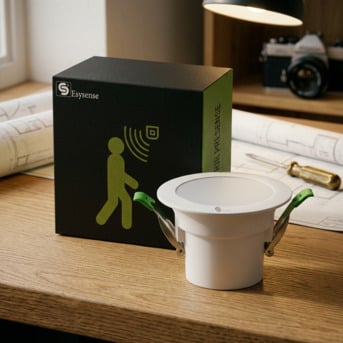
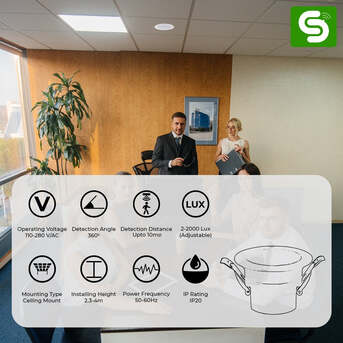
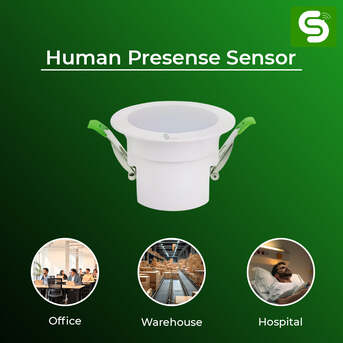
A presence sensor keeps lights on for a stationary occupant — a seated person at a desk, a student in a lecture, a patient in a hospital bed — whereas a standard motion sensor switches lights off after a short period of no gross movement. The Esysense Human Presence Sensor (high-sensitivity PIR/radar, ceiling mount) is for offices, classrooms, and libraries where people remain still for extended periods. The Esysense PIR Presence Sensor with Remote adds wireless configuration from floor level — essential for commercial ceiling installations where ladder access is inconvenient.
1. Human Presence Sensor
(i) Detection: High-sensitivity PIR/Radar
(ii) Mounting: Ceiling
(iii) Remote Control: No
(iv) Best For: Offices, Classrooms, Libraries & Hospital wards
(v) Product Link: esysense.com/products/human-presence-sensor
2. PIR Presence Sensor with Remote
(i) Detection: High-sensitivity PIR
(ii) Mounting: Ceiling or Wall
(iii) Remote Control: Yes (IR/RF Remote)
(iv) Best For: Commercial offices, Large meeting rooms & Conference spaces
(v) Product Link: esysense.com/collections/smart-sensors
Presence sensors: esysense.com/collections/smart-sensors
The fundamental distinction between motion and presence sensing: a motion sensor answers 'Is anyone moving?' — a presence sensor answers 'Is anyone here?' This difference determines whether or not a seated, focused person experiences their lights switching off in the middle of their work.
Presence Sensor vs Motion Sensor — Key Differences
1. Presence Sensor
(i) Detects Walking / Large Movements: Yes
(ii) Detects Seated or Stationary Occupants: Yes
(iii) Suitable For Offices & Study Rooms: Excellent
(iv) Suitable For Corridors & Bathrooms: Yes
(v) Detection Technology: High-sensitivity PIR or Radar
(vi) False-Off Risk: Very Low
(vii) Best For: Offices, Classrooms, Libraries, Hospitals, Meeting rooms & Study areas
2. Standard Motion Sensor
(i) Detects Walking / Large Movements: Yes
(ii) Detects Seated or Stationary Occupants: No
(iii) Suitable For Offices & Study Rooms: Can be disruptive
(iv) Suitable For Corridors & Bathrooms: Yes
(v) Detection Technology: Standard PIR or Radar
(vi) False-Off Risk: Moderate to High
(vii) Best For: Corridors, Bathrooms, Storerooms, Staircases & Pass-through areas
Bottom line:
The presence sensor is specifically needed in any space where people remain seated and relatively still for extended periods. For pass-through spaces (corridors, bathrooms, storerooms), a standard motion sensor is sufficient and more economical.
How a Human Presence Sensor Works
Standard PIR sensors detect the large, fast infrared signals from walking movement. A human presence sensor uses much higher sensitivity pyroelectric elements and advanced signal processing to detect the subtle, slow infrared variations from:
(i) Breathing — chest rises and falls approximately 5-10mm per breath, creating a measurable infrared variation at close range.
(ii) Weight shifts — a seated person imperceptibly shifts posture every few minutes, creating a detectable micro-movement.
(iii) Hand and arm movements — typing, writing, and reaching are all detectable by high-sensitivity PIR even at low amplitude.
(iv) Radar presence detection (microwave variant) — detects millimeter-scale Doppler shifts from breathing and fine movements.
Bottom line:
The result: the presence sensor maintains the light in the ON state as long as a person is genuinely in the room — even if they are reading silently and not moving significantly for several minutes.
Where Presence Sensors Are Needed in Indian Buildings
1. Office Workstations
(i) Why Standard Motion Sensors Fail: Employees spend long periods seated at desks Keyboard work creates very little movement Lights may switch off after 5–10 minutes of inactivity.
(ii) Why Presence Sensors Work: Detect micro-movements and breathing. Keep lights on throughout the workday.
2. Meeting Rooms
(i) Why Standard Motion Sensors Fail: Attendees often sit still during presentations Passive listeners generate little detectable movement.
(ii) Why Presence Sensors Work: Detect subtle occupant presence Maintain lighting for the entire meeting.
3. School & College Classrooms
(i) Why Standard Motion Sensors Fail: Students remain seated during lectures Minimal movement can cause nuisance switch-offs.
(ii) Why Presence Sensors Work: Continuous occupancy detection keeps lights active throughout class.
4. Library Reading Rooms
(i) Why Standard Motion Sensors Fail: Readers may remain almost motionless for extended periods.
(ii) Why Presence Sensors Work: Detects ongoing presence even during quiet reading sessions.
5. Home Study Rooms
(i) Why Standard Motion Sensors Fail: Students preparing for exams often remain seated for hours.
(ii) Why Presence Sensors Work: Maintains uninterrupted lighting during study sessions.
6. Hospital Patient Rooms
(i) Why Standard Motion Sensors Fail: Patients may have limited mobility or remain in bed.
(ii) Why Presence Sensors Work: Can detect breathing and tiny body movements Ensures lighting remains available when needed.
Bottom line:
In a typical Indian office, presence sensors in workstations and meeting rooms reduce lighting electricity by 40-60% compared to always-on manual switching — while completely eliminating the disruptive false-off experience that standard motion sensors cause in occupied rooms.
PIR Presence Sensor with Remote — Why the Remote Matters
Commercial ceiling installations position sensors at 3+ meter height. Adjusting settings without a remote requires a ladder every time. The remote control allows:
(i) MODE button: toggle between presence mode (stationary detection) and motion mode (standard timer-based)
(ii) SENS +/-: adjust detection sensitivity from floor level — no ladder access needed during commissioning
(iii) TIME +/-: adjust auto-off delay remotely — extend during a conference, reduce after business hours
(iv) ON/OFF: manual override — force lights on or off regardless of sensor state
(v) LUX +/-: adjust day/night ambient light threshold without accessing the sensor body
Recommended settings for an Indian office cabin: Mode: Presence Sensitivity: Medium (3-5m for a 12-15 sqm cabin) Delay: 10-15 minutes LUX: Disabled (interior office, no day/night gating needed).
Bottom line:
The remote-controlled presence sensor is the professional choice for commercial installations — it saves significant commissioning time and allows facility managers to adjust settings without scaffold or ladder access during normal operation.
Energy Savings with Presence Sensors in Indian Offices
1. Office Workstation
(i) Manual Lighting Runtime: 10 hrs/day (9 AM–8 PM)
(ii) Presence Sensor Runtime: 6 hrs/day (actual occupancy)
(iii) Monthly Saving (15W Panel @ Rs.8/unit): Rs.576
2. Meeting Room
(i) Manual Lighting Runtime: 10 hrs/day
(ii) Presence Sensor Runtime: 4 hrs/day (approximately 40% occupancy)