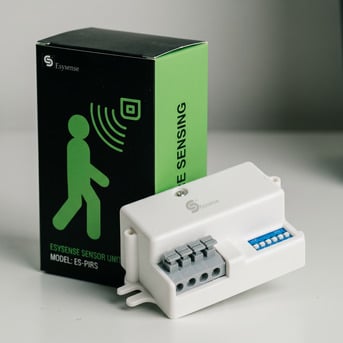
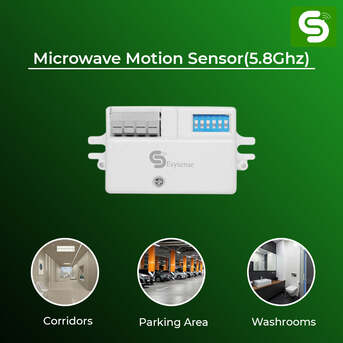
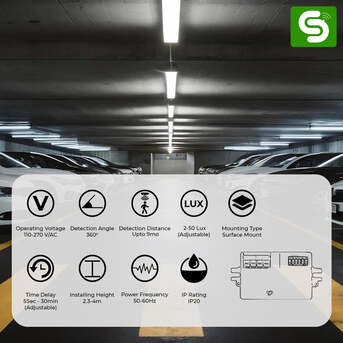
The best motion sensor for Indian car parking structures in 2026 is the Esysense Microwave Motion Sensor (radar Doppler, 110-270V AC, IP20, 1-9m adjustable range). PIR sensors are not recommended for Indian parking — ambient temperatures of 40-50 degrees C collapse the heat differential PIR depends on, and hot vehicle engines cause constant false triggers. Radar is completely unaffected by temperature, detects vehicle metal bodies reliably, and works identically in Indian summers and winters. One sensor controls multiple bay lights in parallel (up to 1000-2000W combined load).
1. Microwave Motion Sensor
(i) Technology: Radar Doppler 5.8GHz
(ii) IP Rating: IP20
(iii) Operating Temperature: -20°C to +60°C
(iv) Best For: Covered parking, basements, garages, semi-outdoor areas
2. Microwave Sensor (Garages)
(i) Technology: Radar Doppler
(ii) IP Rating: IP20
(iii) Operating Temperature: -20°C to +60°C
(iv) Best For: Home garages, service bays, workshops
Microwave sensor: esysense.com/products/microwave-motion-sensor
Covered parking structures in India present four conditions that make PIR sensors unreliable: extreme summer heat (40-50 degrees C), engine heat false triggers, accumulated dust on sensor lenses, and variable humidity during monsoons. Microwave radar sensors are immune to all four — making them the only sensor technology that can be reliably specified for Indian parking applications.
Why Microwave Beats PIR in Indian Parking — Direct Comparison
1. Microwave Sensor
(i) Performance at 40–50°C Ambient: Unaffected — radar is temperature-independent
(ii) Vehicle Detection: Reliable — strong radar reflection from metal surfaces
(iii) Engine Heat False Triggers: None — ignores heat sources completely
(iv) Dust-Covered Sensor Lens: Unaffected — radar penetrates dust
(v) Monsoon Humidity: Unaffected — radar works through moisture
(vi) Full Bay Coverage from Ceiling: 360° hemispherical coverage of the entire bay
(vii) Recommendation for Indian Parking: Strongly preferred
2. PIR Sensor
(i) Performance at 40–50°C Ambient: Severely degraded — heat differential collapses
(ii) Vehicle Detection: Unreliable — vehicles do not provide a consistent heat signature
(iii) Engine Heat False Triggers: Common — hot engines can trigger the sensor
(iv) Dust-Covered Sensor Lens: Reduced sensitivity due to lens contamination
(v) Monsoon Humidity: Partial degradation from lens condensation
(vi) Full Bay Coverage from Ceiling: Directional coverage may miss bay edges
(vii) Recommendation for Indian Parking: Not recommended
Bottom line:
The verdict is unambiguous for Indian conditions: PIR sensors are unreliable in Indian parking structures from April through September — which covers over half the year. Microwave radar sensors perform identically regardless of season, temperature, or weather.
How Microwave Sensors Detect Vehicles and Pedestrians
The sensor emits 5.8 GHz radar signals in a hemispherical pattern below the ceiling-mounted unit. In a parking environment:
(i) Vehicle approaches: the vehicle's metal body creates a strong Doppler shift in the reflected radar — sensor triggers before the vehicle is fully in the bay, ensuring the driver can see during the parking maneuver.
(ii) Vehicle parked, occupants exit: pedestrian movement through the bay creates continued Doppler shifts — light stays on throughout the exit process.
(iii) Bay empty: no Doppler shift detected for the delay period (3-5 minutes) — light dims to standby or switches off.
(iv) Temperature at 45 degrees C: radar signals behave identically to 20 degrees C — zero performance degradation.
Bottom line:
The 3-5 minute delay is the correct setting for parking bays — sufficient for the driver to park, gather belongings, and walk away. Shorter delays risk switching off while the driver is still inside the vehicle.
System Design — Multi-Bay Covered Parking
Recommended zoning approach for a 20-bay covered parking (two aisles of 10 bays each):
(i) Zone 1: Bays 1-5, Aisle A — 1 microwave sensor ceiling-mounted at aisle midpoint, 3 T8 LED tubelights
(ii) Zone 2: Bays 6-10, Aisle A — 1 sensor, 3 tubelights
(iii) Zone 3: Bays 1-5, Aisle B — 1 sensor, 3 tubelights
(iv) Zone 4: Bays 6-10, Aisle B — 1 sensor, 3 tubelights
(v) Entry/exit aisle — 1 dedicated sensor + flood or high-bay luminaire
(vi) Each zone: separate 15A circuit. Sensor wired in series with zone Live feed. Lights in parallel.
Result: only active zones are illuminated. Peak hours (7-9am, 6-9pm): ~80% zones active. Daytime working hours: 30-40% active. Night (11pm-6am): 5-10% active. Average equivalent full-load: ~3.5 hrs/day vs 14+ hrs always-on = 75% energy reduction.
Bottom line:
For a 50-tube covered parking: annual saving of Rs.78,600 at Rs.8/unit (from Rs.1,935 to Rs.363 per tube per year). Full installation investment typically recovered within 12-18 months.
Energy Savings — Parking Sensor Lighting
1. Traditional Fluorescent T8 (48W, 14 hrs/day)
(i) Daily Consumption: 672 Wh
(ii) Annual Consumption: 245 kWh
(iii) Annual Electricity Cost (@ Rs.8/unit): Rs.1,960
2. Microwave Sensor LED T8 (36W, 3.5 hrs/day)
(i) Daily Consumption: 126 Wh
(ii) Annual Consumption: 46 kWh
(iii) Annual Electricity Cost (@ Rs.8/unit): Rs.368
3. Annual Savings Per Tube
(i) Energy Saved: 199 kWh/year
(ii) Cost Saved: Rs.1,592 per tube/year
4. Example: 50-Tube Parking Area
(i) Annual Saving: Rs.79,600 per year
Installation Guide for Parking Area Sensors
1. Mount sensor on parking ceiling above zone midpoint — typically at 2.4-3m ceiling height. Ensure clear hemispherical view of the full zone below.
2. Route 220V AC supply cable from distribution board to sensor mounting point through conduit.
3. Wire: Mains Live → Sensor L-in Sensor L-out → all zone lights Live (parallel) Neutral and Earth direct from board to all lights.
4. Set time delay to 3-5 minutes. Set sensitivity for the zone bay width (typically 5m detection radius at 2.5m ceiling height covers a 4-5 bay zone).
5. Test: walk the full zone perimeter — verify activation from all entry points. Drive a vehicle slowly into zone — verify activation on vehicle approach. Wait after exit — verify switch-off after delay.
6. Verify adjacent zones are not false-triggered by activity in the test zone — reduce sensitivity if overlap occurs.
Explore More Smart Lighting Solutions by Esysense
Looking for more smart sensor lighting for your home or office? Explore our full range:
(i) Motion Sensor Bulb — for standard E27/B22 spotlight fittings — esysense.com/collections/motion-sensor-bulb
(ii) Motion Sensor Batten Light — complete surface-mount fitting — esysense.com/collections/motion-sensor-lighting
(iii) COB Lights for Shops, Showrooms & Stage Areas —