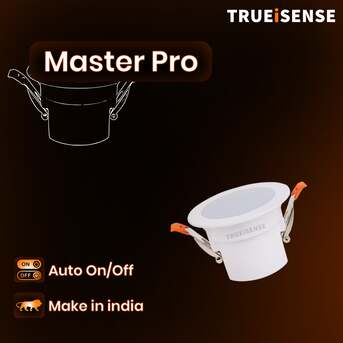
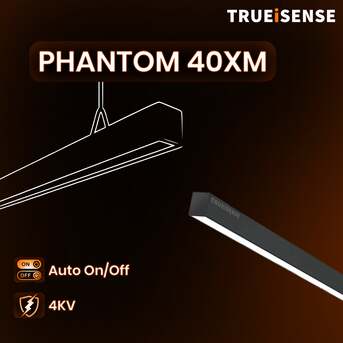
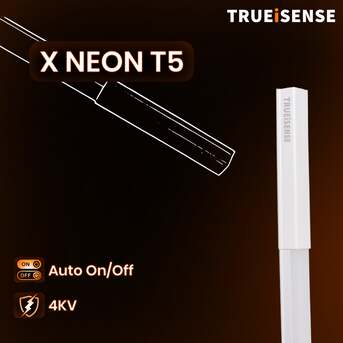
Motion sensor LED lights automatically illuminate industrial areas only when workers, forklifts or vehicles are present. TRUEiSENSE offers industrial lighting solutions including Motion Sensor T8 LED Tube Lights, PHANTOM-XM Motion Sensor Linear Lights, OCT-XLURA High Bay Lights, OCT-XMAXX Well Glass Lights and advanced True Presence Sensors for manufacturing facilities, warehouses and production units. Industrial facilities can typically reduce lighting energy consumption by 40–80% through intelligent motion-based automation.
TRUEiSENSE Industrial Lighting Product:
1. OCT-XLURA High Bay
Industrial Application: Manufacturing floors
Key Feature: High-mount occupancy lighting
2. OCT-XMAXX Well Glass
Industrial Application: Industrial zones
Key Feature: Presence-sensor operation
3. PHANTOM-XM Linear Light
Industrial Application: Production lines
Key Feature: Motion-activated lighting
4. Motion Sensor T8 Tube Light
Industrial Application: Utility areas
Key Feature: Automatic ON/OFF
5. ORO PRO 360° Motion Sensor
Industrial Application: Retrofit projects
Key Feature: Ceiling-mounted sensing
6. OCT Master Pro
Industrial Application: Workstations
Key Feature: True presence detection
7. Crux Detector
Industrial Application: Smart factories
Key Feature: Advanced occupancy monitoring
Industrial Lighting Solutions: https://trueisense.in/pages ...
Free Energy Assessment: https://trueisense.in/pages ...
Why Do Manufacturing Facilities Need Motion Sensor LED Lights?
Manufacturing plants often operate lighting systems continuously throughout the day and night. Large factory floors, storage areas, loading docks and utility zones remain illuminated even when unoccupied.
This leads to:
(i) Higher electricity costs
(ii) Increased maintenance expenses
(iii) Reduced lamp life
(iv) Unnecessary carbon emissions
Motion sensor LED lights solve these challenges by activating lighting only when activity is detected. This creates a more efficient and sustainable industrial lighting solution.
Bottom Line:
Manufacturing facilities waste significant energy through unnecessary lighting operations. Motion sensor LED lights eliminate this waste.
How Do Motion Sensor Lighting Systems Work in Manufacturing Plants?
Motion sensor lighting systems use intelligent sensors to detect movement within industrial spaces.
When movement is detected:
(i) Lights switch ON automatically.
(ii) The area remains illuminated while activity continues.
(iii) Lights dim or switch OFF after inactivity.
Common detection targets include:
(i) Workers
(ii) Forklifts
(iii) Material handling equipment
(iv) Maintenance staff
(v) Warehouse vehicles
Bottom Line:
Lighting operates only when needed, reducing energy consumption without affecting productivity.
Best Industrial Zones for Motion Sensor LED Lights
(i) Production Floor
Recommended Solution: OCT-XLURA High Bay
(ii) Warehouse Aisles
Recommended Solution: Motion Sensor High Bay
(iii) Loading Docks
Recommended Solution: OCT-XMAXX Well Glass
(iv) Utility Rooms
Recommended Solution: Motion Sensor T8 Tube
(v) Maintenance Areas
Recommended Solution: PHANTOM-XM Linear Light
(vi) Storage Areas
Recommended Solution: ORO PRO Motion Sensor
(vii) Assembly Sections
Recommended Solution: OCT Master Pro
(viii) Quality Control Rooms
Recommended Solution: Crux Detector
Bottom Line:
Different industrial zones require different sensor technologies to maximize energy savings.
Why Are Highbay Lighting Solutions Important?
Manufacturing facilities typically use highbay lighting because of their high ceilings and large floor areas.
Traditional highbay lighting often remains ON continuously, even when areas are vacant.
TRUEiSENSE Highbay Lighting Solutions provide:
(i) Occupancy-based control
(ii) Reduced electricity consumption
(iii) Longer fixture life
(iv) Improved operational efficiency
(v) Lower maintenance costs
The OCT-XLURA High Bay is designed specifically for industrial and warehouse environments where conventional lighting systems often waste energy.
Bottom Line:
Energy-efficient LED high bay lights become significantly more effective when combined with occupancy-based automation.
Motion Sensor vs Presence Sensor for Manufacturing Facilities
Many manufacturing managers ask which technology is best.
Motion Sensors Are Ideal For:
(i) Warehouse aisles
(ii) Forklift routes
(iii) Loading areas
(iv) Utility spaces
(v) Production corridors
Presence Sensors Are Ideal For:
(i) Operator workstations
(ii) Control rooms
(iii) Quality inspection areas
(iv) Administrative offices
(v) Engineering departments
TRUEiSENSE True Presence Sensors detect micro-movements and seated occupants, making them ideal for industrial workspaces where personnel remain stationary.
Bottom Line:
Motion sensors work best in active zones, while presence sensors excel in occupied workstations.
How Much Energy Can Manufacturing Facilities Save?
Potential lighting energy savings include:
(i) Warehouse aisles: 50–80%
(ii) Production areas: 40–60%
(iii) Utility rooms: 70–80%
(iv) Loading docks: 50–75%
(v) Maintenance areas: 60–80%
(vi) Offices within factories: 40–70%
When combined with smart lighting controls and energy monitoring systems, facilities can achieve even greater efficiency improvements.
Bottom Line:
Most manufacturing facilities can realistically reduce lighting energy consumption by 40–80%.
Can Motion Sensor Lighting Integrate with Smart Factory Systems?
Yes. Modern industrial lighting solutions increasingly integrate with:
(i) Energy Monitoring Systems
(ii) Smart Lighting Dashboards
(iii) Building Management Systems
(iv) IoT Platforms
(v) Factory Automation Software
This enables facility managers to monitor:
(i) Energy usage
(ii) Occupancy patterns
(iii) Lighting runtime
(iv) Maintenance requirements
(v) Sustainability targets
Bottom Line:
Connected lighting systems provide both energy savings and valuable operational insights.
Frequently Asked Questions
Q: What is the best motion sensor LED light for manufacturing facilities?
A: OCT-XLURA High Bay, PHANTOM-XM Linear Light and Motion Sensor T8 Tube Lights are among the most suitable industrial lighting solutions depending on the application.
Q: How much energy can industrial motion sensor lighting save?
A: Manufacturing facilities typically achieve energy savings between 40% and 80%.
Q: Are motion sensor LED lights suitable for warehouses?