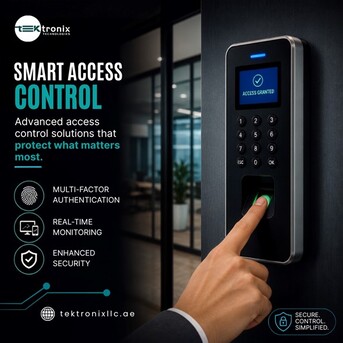
Biometric Access Control Dubai: Eliminating Buddy-Punching at Warehouse Gates
Credential sharing - one worker scanning another's card to register a shift arrival — is the single most exploited vulnerability in warehouse access control, simultaneously creating a time-and-attendance fraud risk and an unrecorded security event where an unauthenticated individual gains access to a controlled facility. Biometric Access Control Dubai deployments by Tektronix LLC at JAFZA and Dubai Industrial City warehouse facilities replace card-only authentication with fingerprint or facial recognition verification at every workforce entry turnstile - ensuring that the person presenting the credential is biometrically confirmed as the enrolled individual before the turnstile releases.
For high-throughput shift-change gates where authentication speed is critical, Tektronix LLC deploys ZKTeco SpeedFace and Suprema Face Station platforms - readers with sub-500-millisecond facial recognition that process workers at natural walking pace without queue formation. At 300 authentications per hour per lane, a four-lane gatehouse handles a 1,200-worker shift change in the ten-minute arrival window without operational disruption. The simultaneous time-and-attendance integration feeds shift arrival data directly to the operator's payroll system - eliminating the manual reconciliation process that paper- and card-based systems require.
Security Access Control System: Bonded Zone and Customs Boundary Enforcement
The most security-critical boundary in a UAE bonded warehouse is the customs-controlled line between the general yard and the bonded storage area - a boundary where a credential error does not merely create a security incident but a potential customs violation with Federal Customs Authority (FCA) regulatory consequences. A Security Access Control System for bonded warehouse applications must enforce this boundary at the hardware level, with zone permission matrices that make it architecturally impossible for an individual without explicit bonded zone authorisation to open a bonded area door, regardless of what credential they present.
Tektronix LLC configures bonded zone access on dedicated controllers with independent audit log storage - ensuring that the bonded area access record is maintained separately from general facility access events and can be exported in the format required by FCA and JAFZA customs compliance audits without exposing unrelated operational access data. Anti-passback enforcement at bonded zone entry and exit turnstiles creates a real-time headcount record for the controlled area, enabling the facility's customs compliance officer to produce an accurate occupancy report for any moment in the past 90 days within seconds of an FCA inspector's request.
Door Access Control System and Access Control Device: Hardware for UAE Industrial Conditions
A Door Access Control System designed for UAE warehouse and logistics environments must withstand conditions that eliminate most commercial-grade hardware from consideration. Loading bay roller doors, cold store vestibule entry points, and outdoor gatehouse reader positions face ambient temperatures exceeding 50°C, humidity swings from near-zero to 95% at coastal facilities, forklift vibration transmitted through concrete floors to wall-mounted readers, and the physical abuse of high-footfall industrial entry points operating 24 hours a day.
Tektronix LLC specifies the Access Control Device for each warehouse access point from a portfolio validated for UAE industrial conditions:
• Outdoor Gatehouse Readers: IP66-rated, IK10 vandal-resistant biometric terminals with anti-glare screens - validated for 50°C continuous operation at JAFZA and Dubai Industrial City outdoor installations
• Cold Store Entry Readers: Anti-condensation heated reader enclosures for cold store vestibule installations where temperature transitions from +25°C yard to -25°C frozen store create condensation events that destroy unrated hardware within weeks
• Loading Bay Pedestrian Access: Recessed flush-mounted readers at loading bay pedestrian doors — positioned to avoid forklift strike zones while remaining accessible to workers in high-visibility vests and gloves without requiring glove removal for PIN entry
• Long-Range UHF Vehicle Readers: 6 to 10 metre read-range UHF credential readers at vehicle entry barriers - integrated with ANPR cameras to provide dual vehicle-identity verification for bonded zone truck access, satisfying FCA vehicle-level access audit requirements
Access Control System UAE: Free Zone Coverage and Regulatory Compliance
An Access Control System UAE-wide warehouse estate - spanning JAFZA and Dubai Industrial City in Dubai, KIZAD and Abu Dhabi Airport Freezone in Abu Dhabi, and Hamriyah and Sharjah Airport International Freezone in the northern emirates - must satisfy the different HSE and security inspection standards of each free zone authority from a single management platform. Tektronix LLC designs multi-site warehouse access control architectures with jurisdiction-specific compliance reporting profiles: JAFZA inspection export formats, PCFC security documentation standards, and KIZAD HSE audit report templates are all configured as scheduled report outputs from the same unified management console - without requiring separate system instances or manual data extraction for each authority.
SIRA compliance for all Dubai-based warehouse installations is managed by Tektronix LLC as a standard project deliverable - including as-built documentation, SIRA equipment compliance certificates, and commissioning test records submitted to the SIRA inspector on the client's behalf. For Abu Dhabi installations, Tektronix LLC coordinates with ADDED (Abu Dhabi Department of Economic Development) and KIZAD authority security requirements, ensuring that every access control installation meets the specific documentation and performance standards applicable to each Abu Dhabi free zone.
Conclusion
The UAE's warehousing and logistics sector operates at a scale, speed, and regulatory complexity that demands access control engineered specifically for its requirements - not adapted from corporate office deployments. Fro