Why Healthcare Data Centers in the UAE Carry Unique Risk
Healthcare workloads carry a different risk profile than general enterprise data. Patient records, imaging archives, and clinical systems are both highly sensitive and operationally critical, meaning a breach or outage doesn't just create a compliance headache, it can directly disrupt patient care. The UAE's growing digital health initiatives and electronic medical record adoption mean more hospitals and clinics are now depending on data center infrastructure they don't directly control, making the security posture of that shared facility a direct extension of each hospital's own patient safety obligations.
What Is Data Center Security?
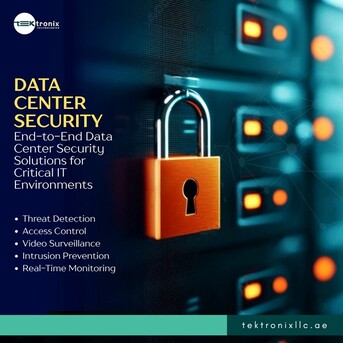
Data Center Security refers to the complete set of physical and digital safeguards that protect servers, network equipment, and the data they hold from unauthorized access, theft, or disruption. It spans everything from the perimeter fence and badge readers at the entrance to the firewalls and monitoring tools protecting the network inside, and the strongest facilities treat all of these layers as one connected system rather than departments that rarely communicate with each other.
Cybersecurity for Data Center Operations Hosting Patient Data
Strong walls and cameras accomplish little if the network behind them is left exposed. Cybersecurity for Data Center environments handling healthcare workloads covers network segmentation between hospital tenants, patch management, vulnerability scanning, and continuous monitoring of traffic moving between racks, not just the connection facing the public internet. Many breaches originate from a compromised vendor laptop or an unpatched management interface inside the facility, which is why digital hygiene deserves the same seriousness as the perimeter fence, particularly where patient data is involved.
Data Center Encryption: Protecting Patient Records at Rest and in Transit
Even with strong perimeter and network defenses, medical data itself needs its own dedicated layer of protection. Data Center Encryption ensures that patient records stored on disk and clinical data moving between servers remains unreadable if it is ever intercepted or physically removed from the building. Properly managed encryption keys, rotated on a defined schedule and stored separately from the data they protect, turn a stolen drive or intercepted packet into something useless to an attacker rather than an open medical record.
Data Center Firewalls: The First Line of Network Defense
At the network edge and between internal segments, Data Center Firewalls filter traffic according to defined security policies, blocking unauthorized connection attempts before they ever reach systems hosting clinical applications. Modern deployments go beyond simple port blocking, applying deep packet inspection and behaviour-based rules to catch unusual traffic patterns that signature-based tools alone would miss, while internal segmentation limits how far an attacker can move if one hospital tenant's segment is ever compromised.
Data Center Access Control: Managing Who Can Reach Healthcare Racks
Physical access remains one of the most overlooked risk areas in any facility hosting medical infrastructure. Data Center Access Control governs exactly who can enter the building, walk into a server hall, or open a specific cabinet, using layered credentials such as biometric verification, smart cards, and mantrap doors between zones. Every entry and exit is logged automatically, giving facility managers a complete, searchable record of who was near a given rack at any given time, which proves essential when investigating a potential breach involving patient data after the fact.
Why Tenant-Level Separation Matters for Healthcare Colocation
Many hospitals and clinics rely on shared colocation facilities rather than dedicated infrastructure, which makes tenant-level access separation especially important. A well-designed access control policy ensures one hospital's IT staff or maintenance contractors cannot physically reach another tenant's racks, even within the same building, regardless of how the broader facility is secured at the perimeter.
Conclusion
Protecting healthcare infrastructure in the UAE now demands a layered approach rather than a single control. Strong Data Center Encryption and Data Center Firewalls guard patient data on the network, while Data Center Access Control and Data Center Surveillance secure the physical building, reinforced by Data Center Intrusion Detection and Data Center Threat Detection working continuously in the background. Combined with disciplined Cybersecurity for Data Center operations, this is what a complete, audit-ready security posture looks like for Data Center Security Dubai and Data Center Security Abu Dhabi healthcare facilities alike. Facility operators evaluating a proven path forward can review Tektronix LLC's perimeter and access security solutions for UAE data centers to compare current controls against a tested, regionally deployed architecture.
For more information contact us on:
Tektronix Technology Systems Dubai-Head Office
[email protected]
+971 50 814 4086
+971 55 232 2390
Office No.1E1 Hamarain Center 132 Abu Baker Al Siddique Rd – Deira – Dubai P.O. Box 85955