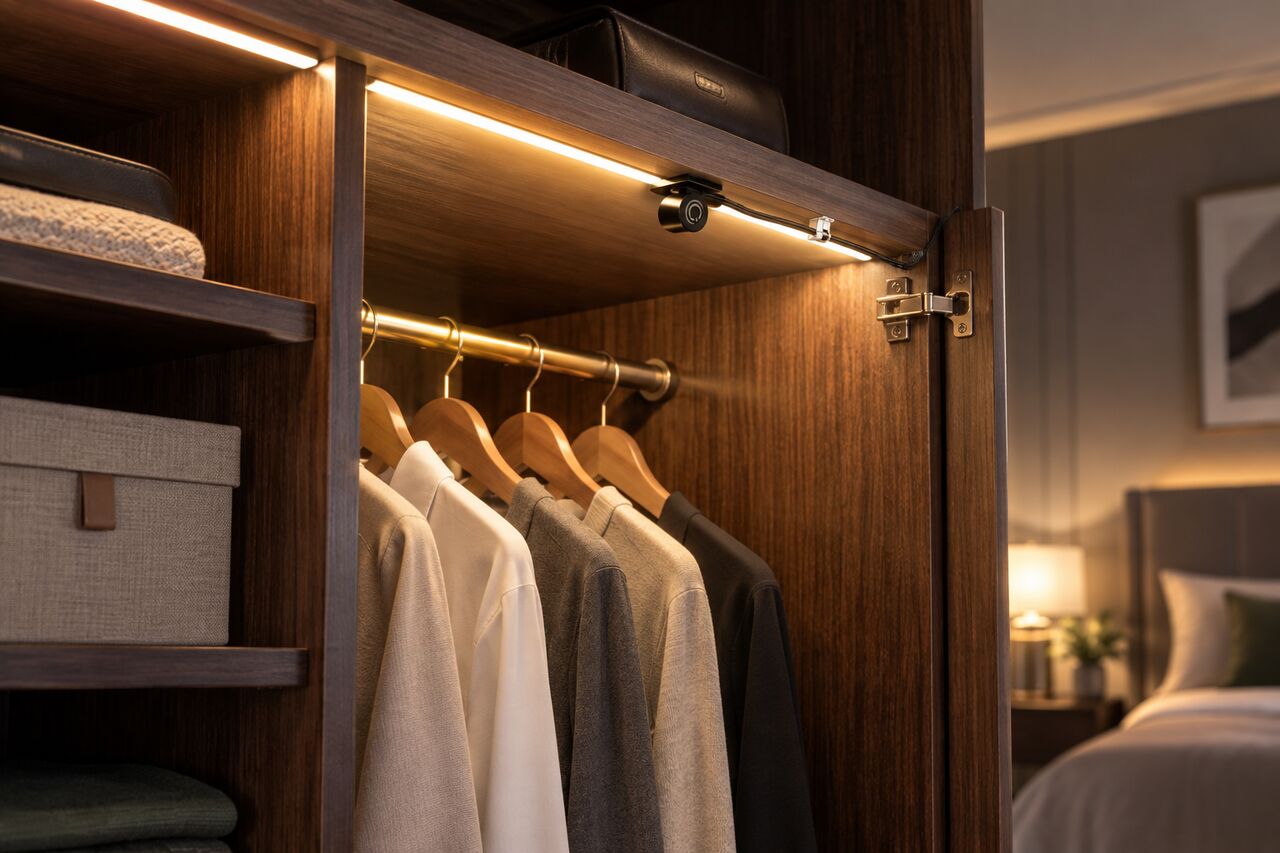
Quick Recommendation
(i) Best non-contact sensor for double-door wardrobes: Esysense ESY-M23 Double Door Cabinet Sensor — Features twin IR proximity probes connected to a central 12V/24V controller to monitor both doors independently.
(ii) Best non-contact sensor for single-door cupboards: Esysense ESY-M22 Single Head Cabinet Sensor — Ultra-compact single IR probe designed for individual cabinet doors, drawers, and single-bay almirahs.
(iii) Best heavy-duty mechanical switch for partition frames: Esysense ESY-TC36 Push Button Switch — A spring-loaded 110–270V AC mechanical switch that cuts power physically when a wardrobe door depresses the plunger.
(iv) Avoid single-head sensors on double-door closets when: Both door leaves access a shared, full-width interior shelf, as opening the unmonitored door leaf will fail to trigger interior lights.
Product Overview
Automated wardrobe sensing technology solves the challenge of dark cabinet interiors by integrating compact optical sensors into custom cabinetry frames.
(i) What it is: An optical or mechanical door-sensing system engineered to detect door movement across single or multi-door wardrobe compartments.
(ii) What it does: Monitors physical door proximity using short-range infrared beams, powering on internal LED strip profiles the instant a wardrobe door opens and turning them off when closed.
(iii) Who it is intended for: Interior designers, modular carpenters, homeowners, and renovators installing modern, hotel-grade closet lighting.
(iv) Primary features: Dual-head IR proximity probes, 5–6 cm non-contact sensing range, low-voltage (12V/24V DC) inline control, sleek recessed or surface mounting, and silent electronic switching.
(v) Key specifications: Max 60W load capacity at 12V DC (120W at 24V DC); 5–6 cm detection threshold; ultra-low standby draw (<0.1W); compact 10–12 mm recessed probe head diameter.
(vi) Main use cases: Master bedroom double-door wardrobes, kitchen crockery cabinets, glass-front display units, and wide pantry closets.
(vii) Important limitations: Non-contact IR probes require a solid door surface within 5–6 cm when closed to reflect the infrared beam back to the sensor head.
Why This Matters
Installing interior LED strips in a double-door wardrobe using a standard single cabinet sensor creates a frustrating design flaw: opening the left door turns the lights on, but opening the right door leaves the interior completely dark. Using a dedicated double door sensor system overcomes this by monitoring both door leaves simultaneously. Whether you open the left door, the right door, or both together, the interior LED profile illuminates instantly.
How Double Door Cabinet Sensor Tech Works
A dual-head double door sensor operates through short-range infrared reflection combined with internal OR-gate electronic logic:
(i) Both Doors Closed (Resting State): Both IR sensor heads continuously emit invisible short-range infrared light beams. When both doors are shut, the interior surface of each door reflects the IR light back into its respective receiving photodiode (within 5–6 cm). The internal controller interprets both signals as "Closed" and keeps the electrical circuit OPEN (Lights OFF).
(ii) Opening Either Door (Left OR Right): Opening one door leaf moves its interior surface away from the corresponding IR probe head. The receiver loses its reflected signal because the IR beam now travels into open space without returning.
(iii) Instant Circuit Closure: The internal microcontroller detects the lost reflection on that probe and instantly closes the power circuit, sending 12V/24V DC power to the connected LED strips in under 0.1 seconds.
(iv) Opening Both Doors Simultaneously: If both doors are opened together, both probes lose their reflected signals, maintaining full illumination across the entire wardrobe bay.
(v) Closing Both Doors: The light remains illuminated until both doors are returned to their closed positions, reflecting IR light back to both probes and signaling the controller to cut power.
Key Technical Mechanisms
(i) Dual Short-Range Infrared Probes: Transmit and receive 850nm IR light pulses calibrated for a precise 5–6 cm detection threshold.
(ii) Integrated Logic Microcontroller: Implements hardware OR-gate logic so that breaking the reflection on either probe triggers the master switch.
(iii) DC Power Switching Circuit: Controls up to 60W of 12V LED lighting without mechanical clicks, sparks, or wear.
Main Decision Factors: Choosing Cabinet Sensors for Wardrobes
1. Door Configuration (Single Leaf vs. Double Leaf)
What to look for: Identify whether the wardrobe section is served by a single door leaf or a pair of adjoining swing doors.
Why it matters: A single-head cabinet sensor monitors one door rebate. Attempting to use a single sensor on a double door forces you to always open one specific door leaf first to get light.
Practical recommendation: Choose the Esysense ESY-M23 Double Door Cabinet Sensor for any wardrobe section closed by two meeting doors.
2. Sensor Technology (Optical IR vs. Mechanical Plunger)
What to look for: Choose between touchless optical IR proximity probes and mechanical spring switches.
Why it matters: Optical IR sensors operate completely silently without mechanical wear, making them ideal for high-end modular wardrobes with hidden 12V LED channels. Mechanical push switches physically break the AC circuit, making them suitable for direct 110–270V AC wiring setups.
Practical recommendation: Use optical IR proximity sensors for sleek, silent low-voltage LED profile channels; use mechanical push switches like the Esysense ESY-TC36 Push Button Switch for direct AC line switching.
3. Mounting Method (Recessed vs. Surface Mount)
What to look for: Check if your cabinet maker can drill small 10–12 mm pilot holes into the top partition frame.
Why it matters: Recessed IR probe heads fit flush into the cabinet frame for a clean, built-in appearance. Surface-mounted probes use double-sided adhesive tape or small screws, making them ideal for retrofitting existing furniture.
Practical recommendation: Specify recessed dual IR probes during initial carpentry for a seamless finish.
Comparison: Double Door IR Sensors vs Single Sensors vs Mechanical Switches
(i) Dual-Head IR Double Door Sensor
Door Coverage: