Quick Recommendation
(i) Best for residential hallways, stairwells & pantries (PIR Motion Sensing): 18W T5 PIR Sensor Tubelight — Features precise body-heat tracking with a 180° detection angle and 60-second auto-off timer to illuminate indoor residential zones without false triggers.
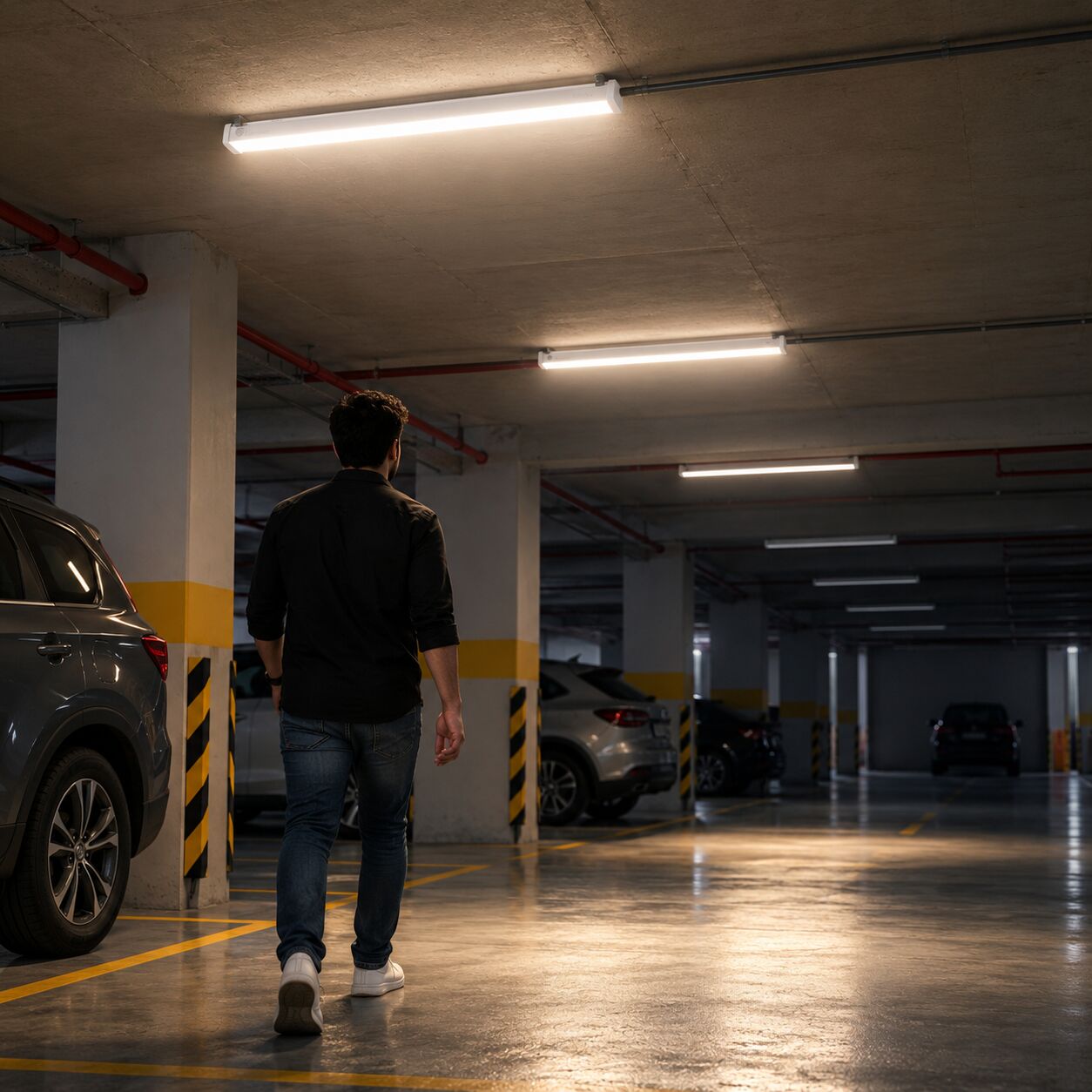
(ii) Best for large commercial corridors, basements & parking garages (Radar/Microwave Sensing): 20W T5 Radar Motion Sensor Tubelight — High-sensitivity microwave radar sensing covers up to 9 meters, detecting movement through light obstacles and glass partitions for maximum safety.
(iii) Best for continuous baseline security with energy savings (Auto-Dimmable): 18W/20W Auto-Dimmable Sensor Tubelight — Maintains a soft 20% to 30% ambient glow in idle conditions and ramps to 100% full brightness instantly when movement occurs.
(iv) Explore the complete range of motion-activated linear lights: Compare specifications, color temperatures (Warm White, Natural White, Cool White), and order directly from the official Esysense Motion Sensor Tubelight.
Product Overview
Automatic linear batten lights combine high-efficiency surface-mounted diode LEDs with built-in occupancy sensors inside a single integrated profile.
(i) What it is: A self-contained linear LED batten (in T5 housing) featuring an integrated PIR or Radar motion sensor and intelligent control driver.
(ii) What it does: Automatically powers the LED tubelight ON (or ramps from dimmed to full output) when motion is detected, switching OFF or returning to standby dimming after 30 to 60 seconds of inactivity.
(iii) Who it is intended for: Homeowners, facility managers, office administrators, residential welfare associations (RWAs), and building operators wanting switch-free linear lighting.
(iv) Primary features: Integrated PIR thermal or Radar microwave sensor, 180° wide detection angle, up to 9-meter detection radius, 60-second auto-off delay timer, auto-dimming standby options, and plug-and-play surface mounting.
(v) Key specifications: Wattage: 18W / 20W; Voltage: 220V–270V AC; Luminous Output: 1,800 to 2,000 Lumens; Length: 2 Feet (T5); Color Temperatures: 3000K Warm White, 4000K Natural White, 6500K Cool White; IP Rating: IP20 indoor protection.
(vi) Main use cases: Residential hallways, building staircases, underground parking garages, office corridors, restrooms, basements, and storage rooms.
(vii) Important limitations: Standard IP20 indoor tubelights must be protected from direct rain or high moisture exposure unless mounted inside waterproof fixtures.
Why This Matters
Linear tubelights in building hallways, staircases, and parking basements are often left powered ON 24 hours a day, causing high electricity bills and accelerating driver wear. Replacing static fixtures with a smart sensor tubelight ensures full light output is delivered only when people are actively present. This eliminates manual switch hunting in dark corridors, improves nighttime safety, and slashes linear lighting electricity costs by over 90%.
How Sensor-Based LED Tubelights Work
An automated LED tube light incorporates built-in detection modules directly within its diffuser profile to monitor human or vehicular movement:
1. PIR (Passive Infrared) Motion Sensing
Indoor PIR models track changes in infrared thermal radiation (body heat) moving across a 180° detection field. When a person enters a hallway or stairwell, the temperature difference between the moving body and the background environment triggers the pyroelectric sensor, closing the internal driver circuit to turn the light ON instantly.
2. Radar / Microwave Motion Sensing
High-sensitivity radar models emit low-power 5.8GHz electromagnetic signals and measure the frequency shift (Doppler effect) of reflected waves. Radar sensors detect subtle movements over wide 360° zones up to 9 meters away and can sense motion through thin partitions, glass doors, and light obstacles, making them ideal for large parking bays and commercial passageways.
3. Auto-Dimming Standby Mode
Rather than turning off completely, bi-level sensor tubelights drop to a low-power 20% to 30% ambient glow (approx. 4W) when an area is vacant. When motion is detected, the driver boosts the LED tubelight output to 100% full brightness (18W or 20W) in under 0.1 seconds, delivering uninterrupted baseline visibility with maximum peak illumination.
Main Decision Factors: Choosing a Sensor Tubelight
1. Sensing Technology: PIR vs. Radar (Microwave)
What to look for: Match the sensor type to your room layout and environmental conditions.
Why it matters: PIR sensors track line-of-sight thermal body heat, making them immune to false triggers caused by movement behind thin walls or doors. Radar sensors cover wider areas and detect rapid vehicular or human motion across open spaces.
Practical recommendation: Choose PIR sensor tubelights for enclosed residential hallways, bedrooms, and stairwells; select radar sensor tubelights for open parking basements, long office corridors, and commercial storage bays.
2. Lighting Logic: Full Auto ON/OFF vs. Auto-Dimming
What to look for: Decide whether total dark shut-off or continuous baseline illumination is required.
Why it matters: Residential storerooms and pantries benefit from full ON/OFF switching to minimize idle power. Public building corridors and basement walkways require a baseline ambient glow so visitors are never faced with pitch-black environments.
Practical recommendation: Deploy full ON/OFF sensor tubelights in utility rooms, home corridors, and restrooms; use auto-dimmable tubelights in shared building hallways, staircases, and parking areas.
3. Physical Size & Mounting Layout
What to look for: Verify fixture length (2 Feet) and profile fitment (T5 integrated batten).
Why it matters: 2-foot T5 battens provide compact lighting for small passageways and landings.
Practical recommendation: Specify 2-foot 18W T5 integrated battens for compact residential zones available in the Esysense Motion Sensor Tubelight.
Technical Specification Comparison
1. Esysense 18W T5 PIR Sensor Tubelight
Sensing Technology: Integrated PIR Thermal Body-Heat Sensor.
Wattage & Lumens: 18W / 1,800 Lumens (100 lm/W).
Housing Profile: 2-Foot T5 Integrated Aluminum-Polycarbonate Batten.
Detection Coverage: Up to 9 meters / 180° field of view.
Delay Timer: Up to 60 Seconds auto-off delay.
Best Application: Enclosed residential corridors, stairwells, pantries, and bathrooms.
2 Esysense 20W T5 Radar Motion Sensor Tubelight